|
HOME |
In & Around Places, environment, history and people |
WEY HACKER "It really surprises me," Milton told Inside Out. "It's the speed, the size of the device and the ease with which it was attached to my computer." pcpro.co.uk 26th March 2007 WEY WALKER WEY AFRICAN WEY BLOGGER WEY LEGAL WEY ENVIRONMENTAL WEY CARNAGE WEY GIG " It was a good stage to play on (despite the sweltering hot lights making us ultra sweaty!) – and with a packed room you could have an awesome gig there." The Rebs 2nd June 2007 WEY DAMP WEY GREEN WEY SAFE WEY BOOKISH The bookshop referred to was probably the cavernous Thomas Thorp store at the top of the High Street. The shop closed its doors in 2003. Ed WEY RICH WEY GOLIGHTLY "I've had my share of rocket disasters," said Green. "We avoided a fire today but I've set cornfields alight before now. Another time I was at a wrap party in Ayrshire, Scotland, and I put on a display for the cast and crew. I didn't properly test the rockets for wind direction so they were flying about all over the place. The scene was complete mayhem. I was yelling, “Run for your lives!” and there were people screaming, "We're all going to die!” It was a firework display with edge. " Green's obsession with rocketry goes back to a childhood ambition to become an astronaut, although his part in the drama Rocket Man probably reignited his hobby. Source: dailymail.co.uk 30th June 2007 WEY QUINTESSENTIAL WEY REDUNDANT "Initially, they were just souvenirs from different pubs I visited," said eccentric collector Nick Stapleton. "I always asked for permission and offered to put money into the pubs' charity boxes. It's like a pension fund for me. I'll just sit on this little lot and get richer and richer.' He could well be right, as china pub ashtrays made by Minton can fetch £60. Source: metro.co.uk 24th June 2007 WEY DAMP "Here in Guildford this weekend the washing has been sitting on the line for over 36 hours and has become measurably wetter. WEY TOP TABLE WEY CANINE WEY SNAPSHOT Mean Temp : 15.2c Source: Phil Layton19th August 2007 layton.me.uk/meteo.htm WEY TAGGED WEY WARTIME "We had air raid shelters erected in everyone’s back gardens 6 ft deep. They were dry in summer but they had 2ft of water in them all winter then they were unusable. "We used to stand in our back gardens and watch the dog-fights between the fighters and bombers, not aware of the danger of falling shrapnel and bullets, until my mums neighbor felt something warm running down her arm, and saw blood she’d been hit with a piece of shrapnel, we never went out to watch again. "After the air raids, all the kids would collect all the shrapnel in their gardens and see who had the most. We had a copse at the bottom of our garden, my mum woke me up one morning in summer and said” come and look” out of the back window the trees were covered in strips of silver foil, glistening in the sunlight it was like Christmas decorations although it was summer. The Germans dropped these to break the radar screen at a nearby radar station." Betty Ford, Guildford resident. Source: WW2 People's War BBC WEY HEROIC WEY FLAMING WEY UNLEADED WEY GHOSTLY "A further search, however, was ordered and the results were chilling. For, just twenty yards from the supposed "crash scene," police found the wreckage of a car containing the remains of a man, buried in twisted undergrowth. Its lights were off - the battery had long since died - and the body was little more than a skeleton. Surrey Police later revealed that the crash had in fact happened in July 2002, and that the vehicle had lain undiscovered for close on five months. "The motorists who had originally alerted the police were, therefore, left to ponder the eerie possibility that what they had seen was a ghostly re-enactment of the original accident."Source: haunted-britain.com WEY DISORDERLY WEY QUAKE WEY LARK WEY THREAT WEY FLORAL WEY REAPER In the borough towns the highest cause of deaths for 20 - 24-year-olds was suicide or 'undetermined' deaths. In urban Guildford the highest cause of deaths in 25 - 29-year-olds were related to vehicle accidents. After the age of 40 most deaths are through heart attacks or chronic heart disease. The report does however show that death rates from cancer, coronary heart disease and stroke are lower in the Guildford area than they are nationally. WEY SHERE Here the vaguely factual history that adorns a chalkboard by the bar (March 2009): "The White Horse was built in 1475 as a farmhouse. It stood in two acres of ground known as Marysee. Made of timbers the inglenook fireplaces were added in the 1600s. It became an inn in the 1700s which coincided with the expansion of Shere into a township (sic) an increase in prosperity from wool and sheep. The inn had its own brewhouse and grew its own hops. "The area was one of the wildest in Surrey with sheep stealers, smugglers and poachers who all found refuge in the hills. Local legend linked the White Horse with the smugglers. This was confirmed in 1955 when a hidden cellar was discovered filled with casks of brandy dating back to 1720. "In Victorian and Edwardian times it was a meeting place for writers and artists. J.M Barrie and Sir Alfred Gilbert (1) are among the many famous names. We also have our own ghost - a young girl whose body was found in the chimney during the 1955 refit." (1) JM Barrie (1860 - 1937) author of Peter Pan. Sir Alfred Gilbert (1854 - 1934) sculptor who created Eros statue at heart of Piccadilly Circus, London WEY THORN WEY DARING WEY HORROR "It’s a beautiful part of the country and has these great rolling hills, but when we first went there it looked really creepy,” said Arnold. “You get lots of shards of light coming through the trees and there are lots of props around. The farm itself looked fantastic and takes on its own character.” Close on 850 actors auditioned for the film. A former Guildford School of Acting pupil Angus Kennedy stars alongside Steve Garry and Michael Dacre. The film is scheduled for independent release later in 2009. Source: Surrey Advertiser 13th March 2009 The film had its first screening at the Guildford Odeon (August 2009) and the producer is hoping that the film will be accepted at world wide film festivals. "We had a full screen so it was the first time a lot of people saw the film, which is always daunting," said producer Colin Arnold. "Lots were jumping at the scary bits and someone near the front got scared and had to stay near the back and that's what you want from a horror film. We've been told of the UK film industry and sales and distribution is in a bit of trouble. We're looking at a DVD release and some terrestrial TV. Video on demand is quite big now so were looking at that as well. They say it's hard to make a film and even harder to sell it. It's interesting dealing with people from around the world and being on conference calls where there is a 12 hour time difference." Source: Surrey Advertiser 21st August 2009 WEY PEDALS WEY CLEVER WEY NUDE WEY GREENER "We know our customers expect us to help them recycle easily and we have also committed ourselves to cutting our own waste," said Alasdair James, Tesco's head of energy, waste and recycling. "This unique pilot helps us do both. Packaging left by customers at the store will tell us a lot about areas we may need to look at again, as well as where we have got it right." Source: naturalnews.com 1st August 2009 WEY RECORD “Saturday went really well but on Sunday I was hit bad because of diarrhoea,” said Lee Chamberlain. “I think it was all the sports drink and food beforehand - my stomach turned into a washing machine. I ended up 20 miles behind schedule when I should have been 20 ahead. I was very despondent and really wanted to give up, I had had enough of feeling ill and just wanted to stop.” He added: “People-watching was brilliant but during the quiet hours I got really delirious. I started naming the mannequins in the Primark window. I also did silly things like try and see how many names I could make with the word ‘Primark’. I still have its blue logo stuck in my head.” Surrey Advertiser 29th July 2009 Chamberlain raised £7,000 for charity in the successful attempt. WEY WARMING WEY CRUEL WEY GREEN WEY RIGHTED WEY FILTHY WEY BATHERS "I cannot understand why the abundance of potholes causes so much concern. Our pothole helps preserve the environment as it makes a favoured bird bath for the local blackbird community. Traffic permitting of course, but perhaps that will not be such a problem with petrol at six pounds a gallon." Bernard Parke. Letters. Surrey Advertiser 16th April 2010 WEY HOOKED? VISIT THE TOWN & PEOPLE OF GUILDFORD MORE ABOUT GUILDFORD ALONG THE WEY
|
|
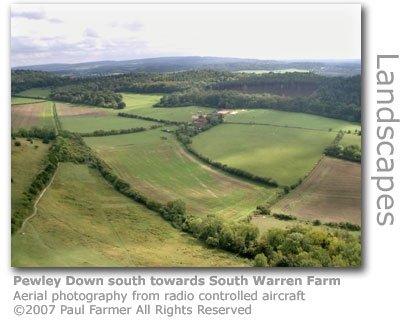
Rare Bird Habitats under English Nature has released a plan (July 2006) to try and defuse a deadlock between Guildford Borough Council, new housing developers and the Government who are threatening to withdraw funds for affordable housing if their deadline is not met. The plan looks at ways of new housing being able to be built within the 5km planning exclusion zone protecting the six Special Protection Areas (SPA) in place in the borough. The SPAs are there to protect rare birds including the Dartford warbler, woodlark and nightjar. MORE HERE Pewley Down At the close of the First World War the now defunct Friary Brewery was a significant landowner in the area, and as well as owning key sites in Guildford where their brewery functions were carried out, the brewery in 1920 bought a substantial part of Pewley Down (GR: SU980485) near the town. The brewery decided to gift Pewley to the town as a war memorial and today the hillside is a popular destination for local people wanting to enjoy the views over the Weald Basin and Surrey Hills.
Pewley Down today is an important conservation site and covers 8.5 hectares of chalk downland forming part of the North Downs. The main habitats here include grassland and woodland which have been protected by designation as a Site of Nature Conservation Interest. It has also been listed as a potential Site of Special Scientific Interest and in June 2006 process for establishing Pewley Down as a Nature Reserve was also started.
A number of rare species are established here including the nationally scarce bastard toadflax (Thesium humifusum), pyramidal orchid (Anacamptis pyramidalis), man orchids (Orchis anthropophora) and autumn ladies tresses (Spiranthes spiralis). Pewley Down is also an important site for butterflies, with almost half of all British butterfly species to be found here. The most notable are the small blue (Cupido minimus), a threatened species in Surrey, the chalkhill blue (Polyommatus coridon), the dingy skipper (Erynnis tages) and the grizzled skipper (Pyrgus malvae). The down is also home to a weevil that is only known to Surrey, glow-worms and the only location in Surrey for the pointed snail.
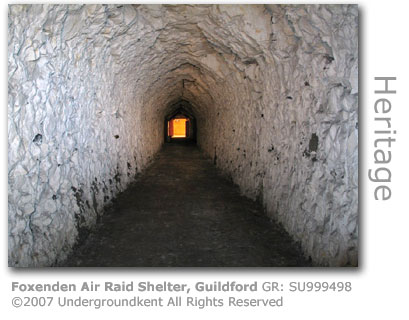
The Pewley Downs Conservation Volunteers (PDCV) actively assist the council's wardens in the protection and upkeep of the down. An important prehistoric trackway ran through Pewley Down which formed part of a route running from the Kent coast. The Roman's adapted the route and in the 19th century it appeared on Ordnance Survey maps as the Pilgrim's Way, although this has been dropped from modern maps in favour of the name North Down's Way as this romantic notion practically suggested that the pilgrims made famous by Chaucer would have to make a 30 mile diversion from their most direct route to Canterbury in order to use it. The road and track today forms part of Route 22 of the National Cycle Network. Currently (2006/7) objectors are fighting a long-running campaign by a mobile phone network provider to erect a telecommunications mast and ancillary equipment on the highest point of the downs. At the edge of Pewley Down along the Hog's Back outside Guildford a military post was built in 1896 becoming one of thirteen positions to the south of London intended to provide defence for the capital against any assault by the French. Henley Fort (GR: SU982489) today is a Grade II Listed Building alongside the old 'Pilgrim's way' and provides an historical education facility and outdoor learning and development centre. In 2005 the centre secured funding from the lottery and Guildford Borough Council to introduce primary school children to wartime experiences from WWII. The fort was converted into a command post of the Home Guard during the war. The children have the opportunity to experience roles undertaken by the Home Guard and the Air Raid Precaution service, and enables them to take part in activities such as air raids, bayonet charges, blackouts and roadblocks. The fort uses genuine wartime equipment including an air raid siren, helmets and decomissioned rifles. The Henley Fort Young People's Enactment Society, which is aided by the Heritage Lottery Fund, provides renactments of the activities of the West Surrey Regiment Volunteers dating to 1900. The fort located at the end of The Mount, overlooks 22 acres of open space for camping, has two bunk houses sleeping 20 people, a dining hall for 80, a Home Guard hut, air raid shelter and powder rooms.
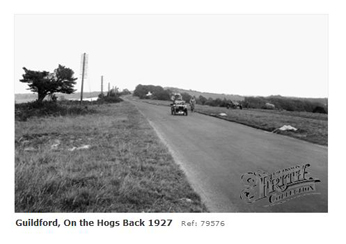
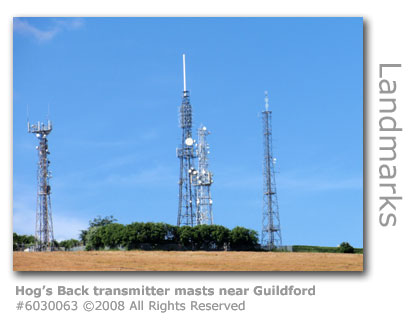
Close to Henley Fort is a high-tech landmark that can be seen clearly for many miles around. Transmitter masts (GR: SU976487) were first erected here in the 1950s on the ridge of the Hog's Back to provide booster signals for radio and television transmissions. Today there are four masts bristling with all manner of transmitters and receivers providing services for users including television, radio, telecommunications and emergency services. The site, identified simply as 'Guildford 10101/140729' by the American-based organisation that currently (2008) maintains it, is secured by high-security fencing and 'anti-vandal paint'. Alongside is the underground Hog's Back Reservoir maintained by Thames Water. The BBC have chosen the Guildford transmitters (June 2008) from where to start testing their introduction of High Definition (HD) broadcasts into the UK through the Freeview service. the trial broadcasts will be received by homes in south west London. They are targeting December 2009 for full HD terrestrial. The track running alongside Henley Fort and the transmitters in centuries past was the main road out of Guildford leading along the Hog's Back to Farnham and it and the original transmitters were used as a location for the BBC television series Doctor Who. In November 1969 scenes for The Silurians (1) were filmed here showing the Doctor and his assistant Liz driving along the track to the fictional Wenley Moor nuclear research centre, for which the transmitter station stood in. The same episode showed the pair navigating through traffic in nearby Godalming High Street on the way to the 'nuclear research centre', a sequence filmed from an upstairs window of what is today The Star public house. Garden Grabbing The change to planning laws introduced by the Tory government a decade or so ago to make building on gardens easier by redesignating them as brownfield instead of greenfield sites continues to create havoc to the urban landscape. Garden developments have escalated wildly with 25% of all new houses in the UK between 2003 and 2006 being built on former residential land. Guildford has not escaped this blight with developers frantic to secure back gardens as the following story recounted by a local resident highlights. Celia Johnson lives on the outskirts of the town and enjoys the facility of a large garden. She has received more than two dozen letters, some of which reportedly take a bullying approach.
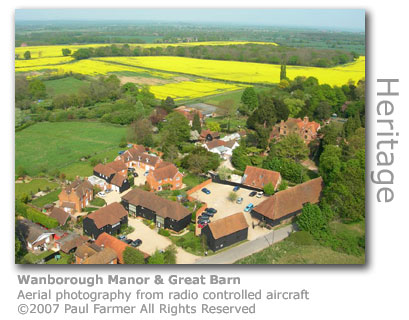
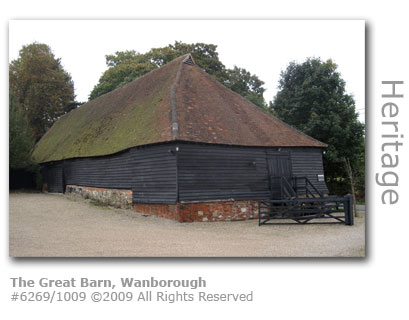
The latest offer was for £800,000 with the developers planning to construct four houses on her land. It seems that this problem is not going to go away despite a growing concern over the extent of garden loss, which has also led to an increased fear of flooding as open land in urban areas reduces the runoff area for heavy rainfall. The government has committed to ever increasing targets for new housing, with much of this pressure falling on southern counties. Source: MORE ABOUT GARDEN GRABBING HERE Wanborough, The Manor In 1388 the Cistercian monks from Waverley Abbey near Farnham built a great barn in which to store the annual harvest of arable crops and sheep fleeces from Wanborough manor which the order controlled. Wanborough Manor at that time was operated as a grange, a farming community run separately from the Abbey, after it had been bought by the order in 1130 for £80.
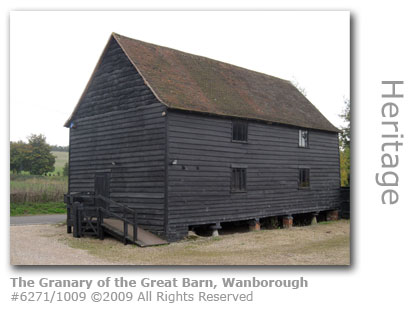
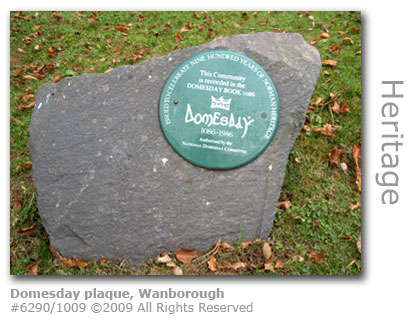
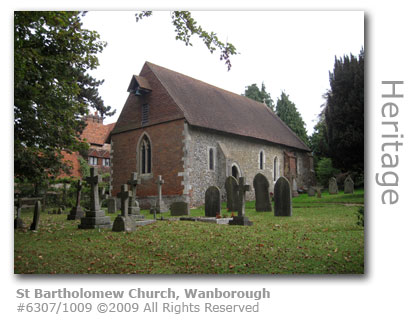
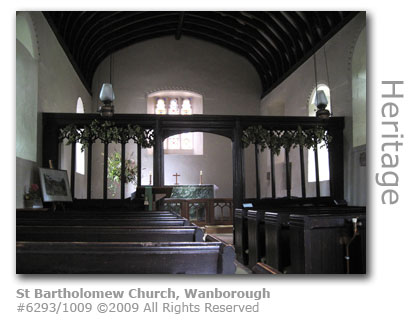
In the picture above, the Great Barn is at bottom right with the courtyard before it, and the manor house is directly above partly obscured by trees. The Cistercian system of recruiting lay brothers, who were men lacking the education to become fully fledged monks but who wanted the discipline of religious life, enabled large farming operations to be run efficiently and dependably for the order under the supervision of a bailiff. The Abbey secured the right to hold an annual fair at Wanborough for three days from August 23rd and also provided for a piepowder court (1) to settle trading and other offences. The abbey was recorded as annually earning £35 by 1536 from the fair. The Great Barn was constructed from huge oak timbers, much of which is still in place today. The original external covering was made of vertical boarding although today this has been replaced with weatherboarding. The building has been extended in more recent times with work undertaken in 1705 and the early 19th century. Alongside the barn is a granary which was built at the end of the 18th century, although its original position was in the front of the manor house. The granary has been converted to provide toilet and kitchen facilities to the barn which can be hired for special functions. Now in the care of Guildford Borough Council the barn is opened to the public periodically throughout the summer with open days coordinated by the Puttenham and Wanborough History Society. Access details are available from Guildford Museum (01483 444751). Wanborough in Thomas Moule’s Description of Surrey published in 1837 was listed as containing 21 houses and 107 inhabitants and at the time the church was in need of repair having fallen into disuse since the 17th century. The hamlet’s name originates from ‘Wenberge’, the Anglo-Saxon name for the White Barrow or ‘bump barrow’, a burial mound located nearby on the Hog’s Back, and is thought to have been the site of settlement since 8000BC. The Domesday Book of 1086 recorded two manors and a church existed in Weneberge (sic) before the Norman Conquest of 1066 at which time it was owned by Sweign and Leofwin, probably brothers to King Harold. It is believed that the Norman army used the chalk ridge of the Hog’s Back to travel to London and laid waste to the hamlet at the time. The Domesday valuation, with the manor then held by Goisfrid de Mandville, provided for assets of three hides (2), a church, nine ploughs (3), with six acres of meadow and woodland valued at 30 hogs (4). A plaque has been erected commemorating the Domesday listing in the churchyard. St Bartholomew Church in Wanborough is a Grade I listed building dating back to the 13th century and is administered by the rector at Seale. The original wooden building was constructed six years before the Norman Conquest (1066) and was rebuilt in stone by the monks from Waverley Abbey in the early 13th century.
All of the walls have been dated to the 13th century and were constructed of flint in mortar with stone dressings, although the west wall was largely rebuilt during the Victorian era in brick. It is on this wall to the outside of the building that a tile-hung gable houses a single bell. The east window dates back to the 15th century with one of the windows in the south wall believed to have been constructed in the 13th century. It wasn’t until 1861 that the Revd W A Duckworth undertook at his own expense to restore the church after almost two centuries of disuse and secured the services of the architect Henry Woodyer. Duckworth appointed a curate at a stipend of £50 per annum and the church was rededicated in the same year. Local records record that a local man was fined in the 17th century for using the building to keep his pigs and chickens.
An endowment fund was started at the time to which local parishioners subscribed in order to maintain the church. In 2007 the parish undertook extensive drainage works around the church in an attempt to eliminate damp in the building. The work cost £10,000 which was met by grants, including £1,500 from the Surrey Churches Preservation Trust, and through fund raising by Friends of Wanborough Church. A book of registers held at the church contains records of baptisms, burials and marriages from 1561 until 1674. Neolithic (4700 – 3000BC) flint implements were discovered in 1870 close to the church as in later years were a Palaeolithic (450000 - 8500 BC) implement and a bronze palstave (5).
Wanborough Manor House dates back to the 16th century, although it was rebuilt and considerably extended during the 17th century by one Thomas Dalmahoy, MP for Guildford. Dalmahoy had married the widowed Duchess of Hamilton who had inherited the manor and the Friary Estate in Guildford. Sir Algernon, who lived at the manor from 1881 and was mentioned in The Times newspaper extract above, was a director of the London and South Eastern Railway and it was largely through his influence that a railway station was built at nearby Normandy (although the station was named Wanborough) in 1849 and served by the South Eastern Railway’s Redhill to Reading line. The Manor House was visited by a great many famous figures including Queen Victoria, Bismarck and Gladstone who held cabinet meetings here whilst in his second period of Prime Minister (6). It is said that William Gladstone made his final farewell speech in the house. HH Asquith, also a Liberal, leased the manor house until he himself became prime minister (1908 – 1916). During World War II the manor was leased to the War Office for the training of wartime agents. SEE BELOW. (1) The Piepowder Courts were a system of tribunals organised by the borough to sit during fairs and markets to control disputes arising during the events. The court had unlimited jurisdiction and usually enforced fines, time held in a pillory (stocks) or being drawn around the fair in a two-wheeled cart or tumbrel. Wartime Secrets The Special Operations Executive (SOE), which was responsible for undertaking sensitive operations in the UK and abroad to support the war effort, requisitioned Wanborough Manor and used it as a base for training British secret agents. The manor was identified as Special Training School 5 (there were six in the country during the Second World War) and was used extensively for secret and intensive selection and training programmes. Local historian Patrick Yarnold has undertaken considerable research into the SOE's activities at Wanborough during the war, and his findings formed the basis of a public exhibition at the nearby Great Barn (July 2007). The first training operations started at the manor in February 1941 and continued until summer 1943 when new selection procedures were established at Winterfold near Cranleigh. British agent Peter Churchill provides a fascinating insight into life at the manor during the war in his book Of Their Own Choice (1). Churchill was on a three-part course run by the French section that began on June 10th 1941 and was subjected to training that included using firearms, working with explosives, undertaking sabotage, map reading and communicating with Morse Code. Only five of the students in Churchill's group were deemed good enough to be deployed to France and all were eventually captured by the Germans. Churchill survived the war after capture in a concentration camp. Two of his fellow students survived Colditz but another was killed at Mauthausen concentration camp. Of a total of about 400 British agents sent to France 130 were trained at Wanborough, and of these 50 failed to return including 12 women. There is a plaque in Wanborough Church commemorating those that lost their lives. One Wanborough-trained agent, Diana Rowden who operated in France under the codename Paulette was captured and executed in 1943 after four months undercover. She was only 29. There is a memorial to her at Tilford Church. Evidence of the secret training sessions remain today with a wall spattered with bullet holes, a tree with large staples still embedded in the trunk, scars in a beech tree from which a glider fuselage had been suspended, and a blasting hole for explosives training. The manor is a private residence and is not open to the public. (1) Peter Churchill was an intelligence officer working with the Special Operations Executive and spent much of the war on active service in France. Churchill was successfully involved in activating British support for the french resistance and helped establish undercover networks. Churchill was captured by the Germans who had infiltrated the Resistance and after being tortured by the Gestapo was sent to a concentration camp. He was freed by the Allies at the end of the war. His book Of Their Own Choice was published in 1952. Sources: Architectural historian Marcus Binney has unearthed documentary evidence that trainee secret agents were tested for their resilience to a ‘honey trap’ at Wanborough Manor during the war. In an article in Country Life (January 2009) he reveals how the agents were tested by plying with alcohol and then subjected them to attempts at seduction by pretty women.
The Looting of Wanborough Temple In the 1980s the quiet and picturesque village of Wanborough became the centre of a legal storm that had national consequences. In 1983 metal detector users exploring the site of the RomanoBritish temple just outside the village unearthed a number of coins. Following archaelogical protocol the finders reported their find to the local museum. However during a coroner's inquest, which is used to determine ownership under 'treasure trove' cases, the location of the site was given out publicly in open court. This led to largescale looting of the site by 'nighthawks' before the Surrey Archaelogical Society could undertake an emergency excavation. There were reports at the time of 30 to 40 looters digging the site at night with estimates that over 8,000 coins worth £2m were lost to looting. One of the looters however was caught red-handed with two artefacts regarded as among the most important ever found in Britain. A new stone temple was built at Wanborough to replace the much older wooden one around 160AD. As a gift to the gods, before the building work started, head-dresses and sceptres were buried on the site by priests who worshipped at the temple. Archaeologists reckon that these priests worshipped Jupiter the Roman sky god because of the wheel decoration found on one of the head-dresses recovered from the site. The head-dresses, which are totally unique and have not been found anywhere else across the Roman Empire, and a pair of handles from sceptres that probably originally measured 3ft (1m) in length – the ones found in the possession of the looter - now reside at Guildford Museum. The find is generally regarded as being one of the most important found in Roman Britain. In 1986 a series of criminal trials were attended by a number of individuals who were accused of looting at the site. Of five cases reported three resulted in convictions. The long term legal implications were considerable. The treasure trove law was the oldest law actively in use in Britain having been introduced in the 12th century. The law was simple in that all findings had to be reported to a coroner who would decide whether the objects had been deposited with intention of recovery. If that was the case and the rightful owners could not be found, then the objects were determined to be treasure and the property of the crown. However if the coroner deemed that the objects had been lost accidentally or buried without intention of recovery, then ownership passed to the landowner. The legal problems that confronted this particular case related to the nature of the site and became quite complex. Widely deemed to have been a temple, confirmed by findings of sceptres and chain headdresses, the coins deposited there were determined to be votive offerings which would mean that the people who deposited them had no intention of recovering them and were not treasure trove. However it was argued during the trial that the objects of gold and silver were unlikely to be votive and were meant to be recovered by their owners given their high value, and this being the case ownership would go to the crown. Without ownership through treasure trove no theft from the crown could be demonstrated. The many impasses at the trials revealed an inherent weakness in the ancient law and resulted in treasure trove being replaced by the Treasure Act in 1996. Sadly further instances of 'nighthawking' at Wanborough, most notably in 1997 and 2005, have been discovered although the perpetuators remain unknown. The impressive red brick building that was built by George John Browne, the Third Marquis of Sligo (1820 - 1896) in 1890 is today the headquarters of Surrey Police who have operated from here since 1949 having secured ownership of the estate in 1947. The family lived here for 50 years. The building located in Sandy Lane, Artington near Guildford (GR: SU988479) has been expanded considerably since then with a four-storey extension having been added in 1969 and another extension in 1975. A further 13 acres of land were added to the estate in 1984 to accommodate the Dog Training School, and in 1998 the facilities at Mount Browne were substantially upgraded to provide state-of-the-art scientific support for criminal investigations. The HQ now sits in 50 acres of parkland and has a staff of 900 people covering 24 hour shifts. The Browne family is of Irish origin with one of the earliest recorded ancestors having been a colonel in the army of James II. John Browne (1660? - 1712) was a legal expert of the time and was party to the Treaty of Limerick in 1691 which ended the war in Ireland between the Jacobites and supporters of William of Orange. Later members of the family continued to attain high ranks in both military and civilian society. The Sligo eagle and initial 'S', both part of the family crest, can be seen above the front door at Mount Browne. The house was originally built with 28 bedrooms and was intended to be a substantial home for the family, although it was just one of many with others in Ireland, London and Brighton. Periodically Mount Browne was let out to provide an income for the family. When Mount Browne and its original 37 acres of gardens and woodland was purchased by the police authority in 1947 for £17,500, the building had extensive alterations to accommodate the needs of its new owners on which £12,000 was spent.
Two bronze memorial tablets are in place each commemorating members of the Force lost during the two wars. Much of the original decor has been preserved in the main building including the highly ornate dining room doors with their detailed wooden inlays, fireplaces and central staircase. An original dovecote with weather vane stands by the preserved garden wall. The house and estate is not freely open to the general public although public meetings and open days are held there. The Surrey Police Museum at Mount Browne is open to visiting groups by prior appointment (01483 482155). The precursor to Surrey Police, the Surrey Constabulary, was formed in 1851 with 70 officers the youngest of whom was 14 years old. By 1899 the number of officers had trebled but the coming of the First World War brought severe manning problems and saw an escalation in the recruitment of women as part-time uniformed officers who served with the Women's Auxiliary Police Corps (WAPC). The first police dog, an Alsation bitch Anna of Avondale, to be formally assigned to Surrey was in 1948 when the Dog Section was effectively formed. Anna was buried at Mount Browne in 1950 and in her honour the annual Anna of Avondale dog trials are held there. Eleven trained civilian scenes of crime officers (SOCOs) were appointed in 1987. There are 1,900 employees working for Surrey Police today with over 1,600 of these being police officers and working within a £173m annual budget (2005/06). These officers are spread across the county in various stations and specialised units. The incoming (January 2007) divisional commander for East Surrey, Chief Superintendant Craig Denholm, has pledged to make neighbourhood policing a priority.
Located within an Area of Outstanding Natural Beauty (AONB) and an Area of High Ecological Value (AHEV) to the south of Guildford is Chantry Wood (GR: TQ012481). Owned by Guildford Borough Council since 1938 but managed by the British Trust for Conservation Volunteers the 78 hectare (193 acre) mixed woodland rises up over the North Downs and offers some of the best views in the borough, especially from Five Fields on the southern boundary overlooking Albury Vale, Chilworth Village and Blackheath. In clear weather it is possible to see as far as the South Downs. Chantry Wood, which is named after a chantry (1) established here in 1486 by Henry Norbrigge, nine-times mayor of Guildford, provides a wildlife habitat consisting of mixed broadleaf and conifer woodland interspersed with unimproved pasture and ponds. Tree species include English oak, red oak, ash, American redwoods, as well as evergreen spruce, cypress and fir. Conservation work on the site focuses on managing the scrub to prevent encroachment onto grassland habitats and coppicing together with hedge laying, tree planting and footpath repair. Chantry Wood was designated a Special Protection Area (SPA) Avoidance Site (with Riverside Park in Burpham) to try and entice dog-walking residents away from sensitive habitats in the borough including Whitmoor Common which is attractive to ground nesting birds including the Dartford warbler, woodlark and nightjar.
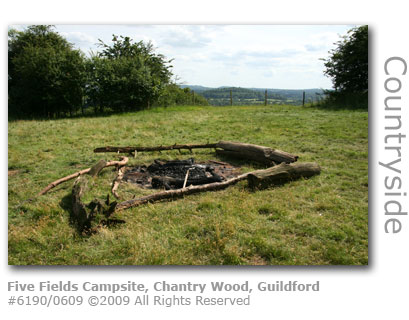
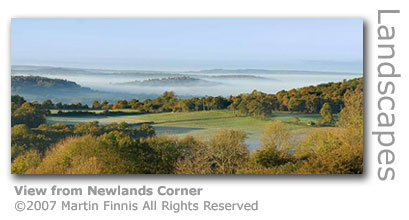
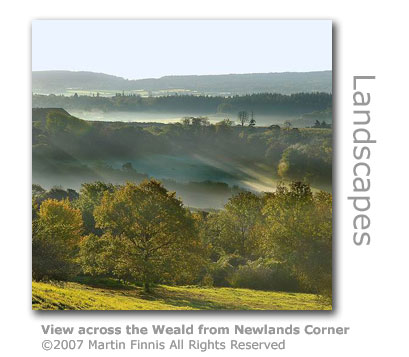
The site is traversed from east to west by the North Downs Way and three way-marked trails have been established. An information leaflet is available in the car park (GR: TQ 00384834) off Pilgrims Way (from A281 Shalford Road). Disabled and pushchair access along main tracks. A campsite is available at Five Fields for youth groups and charities with piped water, a latrine block and wooden building providing additional shelter. Restricted to organised groups prebooking through Parks and Countryside Services at Guildford Borough Council countryside@guildford.gov.uk Chantry Wood is listed within the BBC's Breathing Places scheme. A popular picnic spot off the A25 near Guildford, the 500ft (170m) chalk ridge at Newlands Corner (GR: TQ043493) on the southern boundary of Merrow Downs provides beautiful views across the Surrey Hills towards Martha's Hill, Albury and Shere. There are 105 hectares (260 acres) of open chalk downland set within extensive mixed woodlands which include birch, oak and yew trees, the latter including specimens many hundreds of years old. Green woodpeckers, nuthatches, tawny owls and roe deer are quite common here.
Historically the grasslands here were grazed but now as a public amenity the area is mown once a year after the plants have set seed to keep the grassland open and prevent scrub from invading. In spring and summer a stunning carpet of wild flowers graces the hillside. A large ancient barrow has been recorded nearby with records of ancient flints having been found there. Flint was quarried here in the early twentieth century and the stone, which was destined for use in road building, was often sifted through by archaeologists, as this account from a local resident recalls.
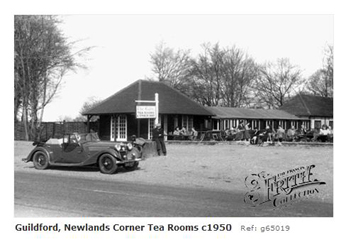
The popular crime writer Agatha Christie added some mystery of her own when in 1926 her car was found abandoned in a chalk pit by Newlands Corner. Her disappearance sparked a nationwide search which culminated in the author being tracked down to a hotel in Harrogate 230 miles (370km) away. Although her behaviour was played down at the time it was rumoured that on the day she vanished Christie had had an argument with her husband and had checked in to the hotel in the name of his alleged mistress. They were to divorce not long after. Newlands Corner, which falls within the Surrey Hills Area of Outstanding Natural Beauty (AONB) that was designated in 1958, is privately owned by the Albury Estate but managed by the Surrey Wildlife Trust and Surrey County Council. Waymarked paths include an Easy Access Trail on a firm surface. The North Downs Way passes through Newlands Corner. There is a large free car park alongside a cafe and information centre which is open all year. The centre, which was funded by the owner of Albury Estates the Duke of Cumberland, Natural England and Surrey County Council, has interactive wildlife games for children and live webcam coverage to show activity in the Wildlife Trust's bird box and wildlife garden. Facilities for the disabled and public toilets including RADAR facility. A self-drive buggy is available for free hire to disabled visitors most Sundays, although it is recommended that a booking is made to ensure availability on 07968 832506.
The area is popular with walkers and mountain bikers, and at weekends car and motorcycle enthusiasts often congregate in the car park to show off their machines. The annual Guildford Three Peaks 10 kilometre cross-country runs start and finish at Newlands Corner. The Surrey Wildlife Trust organises four litter-picking events each year at Newlands Corner in an effort to keep the popular beauty spot clean and to reduce the impact on wildlife. The efforts of 25 volunteers in March 2009 removed 30 bin bags full of rubbish discarded by visitors despite the provision of rubbish bins and signs reminding people not to litter.
A Surrey actor and film producer chose Newlands Corner and nearby Pirbright as locations for a film exploring how a father could find himself resorting to the most extreme situation of taking the life of his own child. Father's Day scenes were shot at the Manor House Hotel in Newlands Corner in February 2009. The film's inaugural screening was at the BAFTA cinema in London in September 2009 and it has been put forward for all the major film festivals for next year.
LANDFILL GAS RECYCLING NEAR NEWLANDS CORNER Merrow was a village in its own right until it became absorbed into the borough of Guildford. Historians argue over the origins of the name with a number of possible derivations. The word ‘mere’ refers to a lake or pool, of which there are several on the lower slopes of Merrow Downs. ‘Mereway’ refers to a ‘way across the moor’ and ‘mear-reaw’ as a boundary row or ridge. At the time of the Domesday Book Merrow was included in the ownership of the crown as part of Kings Park (the Forest of Windsor) under the lordship of Stoke. The town celebrated the annual Guildford Races on Merrow Downs from 1701 until 1870, the first 26 years being an unofficial event. Horses raced a course of two miles (3km) around much of what is now the golf course, with races including flat and jumps. Local historians argue that the Guildford Races prior to the institution of the Derby (1780) and the Oaks (1779) was one of the most important courses in the country. A royal plate was offered at the event with Guildford boasting one of only eleven King’s Plates being raced for in the country. William III gave a King’s Plate of 100 guineas, which was renamed the Queen’s Plate during Victoria’s reign. The wooden grandstand, which was located close to where the golf course’s 12th green is today, was ripped down and burned outside Holy Trinity Church in 1854 during one of the Guildford Guy Fawkes riots (HERE) the town was plagued with for a period. Merrow village sign features the cast iron silhouette of a racehorse against a finishing post and rail.
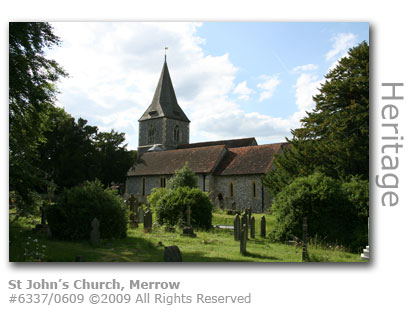
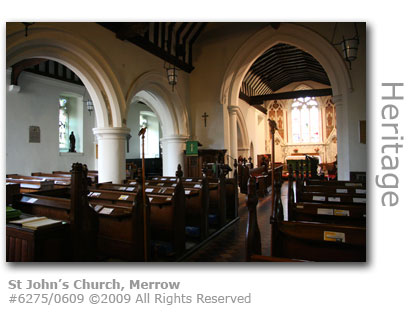
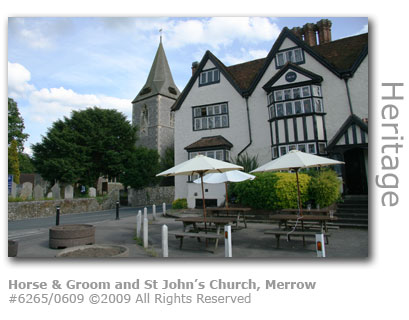
St John the Evangelist Church (GR: TQ029507) sits by The Horse & Groom public House and Trodd’s Lane, which takes travellers up across the downs. The first church recorded on this site was built during the reign of King John in the 12th century and consisted simply of a chancel and a nave. In the 13th century the original building was absorbed into one that provided a south aisle and chapel. Over the ensuing centuries the church eventually fell into disrepair until in the 1830s an unnamed local lady funded a complete restoration which was completed in 1843. The restoration, which incorporated the arcade of the original aisle and part of the chapel walls, is recorded in Latin on a brass plaque in the choir vestry. The addition of the north aisle in 1881 brought the church to the size you see today. The outer walls are faced with knapped flints with the interior finished in chalk. The roof was originally made of Horsham slabs, although all that remains of these now are those on the porch. The chapel to the east of the north aisle, originally a vestry, was added by Lord Daryngton of Witley (formerly Herbert Pike Pease) to honour his son, Ronald Pease, who was killed whilst in action in France in 1916. The highly decorative altar features the patron saints of the four countries of the United Kingdom. His son’s wooden battlefield cross has been mounted on the wall of the chapel. Lord Daryngton was made a peer in 1923 and lived in Merrow until 1925. The wooden lectern in the nave, which was gifted to the church in 1886, is thought to date from the late 16th or early 17th century.
The chapel to the west of the north aisle was converted from its original use as a chantry chapel (1) into a burial vault for the Onslow family who moved to nearby Clandon Park in 1641. The highly influential family provided three Speakers of the House of Commons. Arthur Onslow (1691-1768) the last of the family’s Speakers is interred here along with his wife. There are four Onslow memorial brasses in what today is called the Onslow Chapel, after the Fourth Earl George Onslow gave the chapel back to the church and both arches were freed of their walls opening it up for general worship. The 40 foot (12m) spire, which is clad with Canadian cedar shingles, rests on the tower which was substantially altered in 1842. The shingles were replaced in 2004. The tower has a peal of six bells which were hung in 1898 to commemorate Queen Victoria’s diamond jubilee of the previous year, with the metal of three of the original bells dating from the 17th century included in the new castings. The clock was made by Thwaites & Reed of Clerkenwell, London in 1843.
The village’s War Memorial was erected in the St John’s churchyard in 1920. Two bronze plaques record the names of those from Merrow who died during the two world wars. The memorial bears the inscription ‘This cross was erected by the people of Merrow in memory of the men of the village, who, in the Great War, 1914-1918, laid down their lives for their King and country, in the cause of justice and humanity’. The memorial was dismantled and fully restored in 2002 after £18,000 had been raised, including local donations and a grant from the Heritage Lottery Fund. The villagers have discovered however that the type of stone used in its original construction will warrant the memorial being partially renovated every five years or so at a cost of around £1,600 (2009).
The following poem, Merrow Down, was penned by Rudyard Kipling (1865 – 1936).
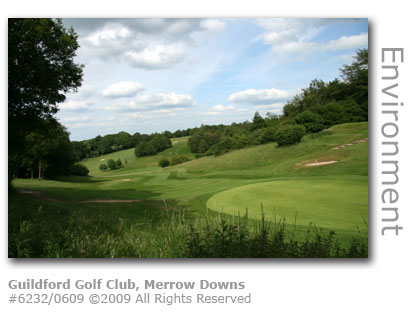
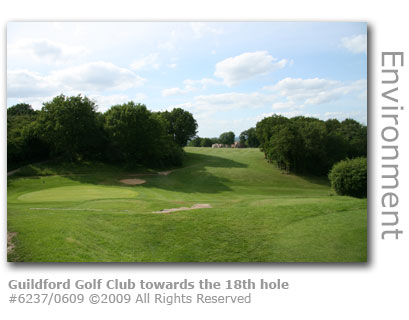
Guildford Golf Club nestles on the side of Merrow Downs and shares its history with a WWII prisoner of war camp and the old racecourse that saw almost 170 years of racing. The club was established in 1886 and as such is the oldest private members club in Surrey. Members have the opportunity of playing on a 6,000 yard (5,486m) course in a magnificent setting. The land was originally part of the Onslow Estate. The course was originally just six holes but was quickly expanded to 18 as the club developed land to the eastern edge of Merrow Downs. In its early days women had their own course but were allowed to play on the full course from 1900. However the women stayed fiercely independent managing their own Guildford Ladies Golf Club for over 100 years until it was amalgamated with the Men’s Club in 2005. The club claims that ‘from the highest part of the course it is possible to see four counties, on a clear day Canary Warf and the City of London’. The clubhouse, which has been considerably enlarged over the years, was built in 1901. The Merrow Cricket Club can trace its history back to a match against Ripley documented in July 1857, although it is believed the club predates that match. In 1887 the annual subscription was five shillings and matches were played on the downs. The following year the club found a permanent home when the 4th Earl of Onslow leased the club a strip of land alongside the Guildford to Epsom road. In those days a players’ tent was pitched to provide some basic facilities and refreshments invariably followed later in the Horse & Groom. A substantial pavilion was erected in 1908 complete with a thatched roof and served the club for 55 years. War stopped play in 1914 and when the club resumed in 1920 it had to take up temporary residence on the downs again as the field had been ploughed over to grow food during the war years. The site where the club played on the downs was where the Defra site (now being redeveloped) is located. The cricket ground was again requisitioned in WWII when it served as a searchlight unit for the Royal Artillery. The present pavilion was built in 1963 funded in part by a grant from the National Playing Fields Association with the balance provided by interest-free loans from 20 of the club’s members. The club joined the Three Counties League in 1977 and the Fuller’s Brewery League in 1992. The Merrow Street Allotment Gardens sited opposite the Horse & Groom has 80 plots and was featured in Channel 4’s television series The Watercolour Challenge. In May 2008 local resident Jeff Howlett added his name to the growing list of people who have reported sighting the Surrey Puma. He spotted the animal in an unnamed car park near the railway. Source: bbc.co.uk 14th May 2008 The following are abridged excerpts from Memories of Merrow published by the Merrow Residents' Association:
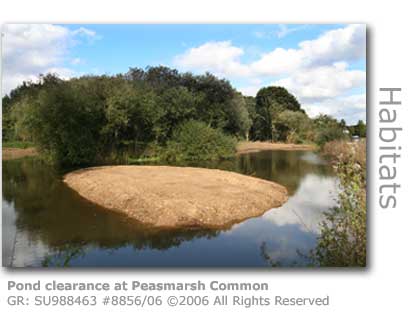
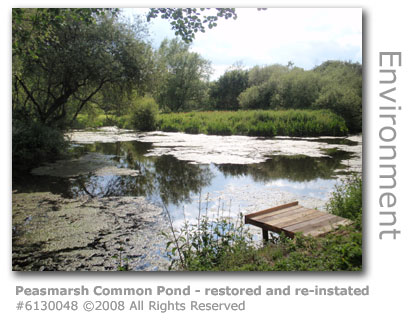
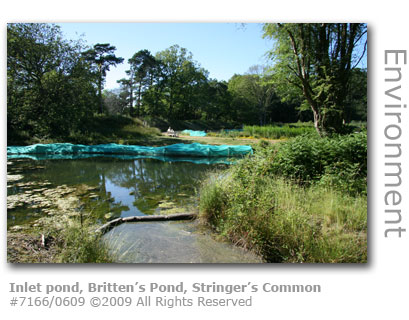
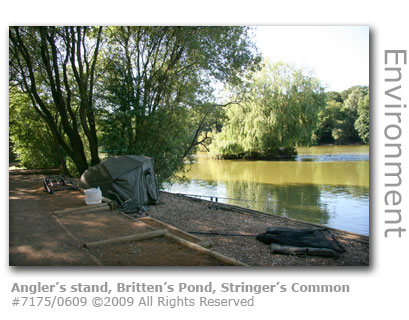
(1) A chantry chapel was usually provided to privately dedicated prayers to a particular benefactor and their family. Peasmarsh Common Peasmarsh Common (GR: SU988463), wedged between the busy Guildford to Godalming (A3100) road and the main London to Portsmouth railway line, covers 15 hectares of which 12 are under protected status. Between 1625 and 1805 'The Peasmarsh' was a large area of common land held between several manors. Predominantly consisting of wet woodland the habitat provides a mix of habitats beneath a canopy of high forest to scrub and water features, at the centre of which is a large pond. Tree species are dominated by oak and willow, and much of the site is under water during the winter months. A private property also takes a central part of the site. The common is fully managed with local responsibility falling to Shalford Parish Council who have secured grant funding for an ongoing improvement of this important woodland habitat. The pond was (September 2006) cleared and reshaped allowing for a new island suitable for wildlife breeding to be created. The banks of the pond had become completely inaccessible through the uncontrolled growth of heavy undergrowth, and this has now been cleared.
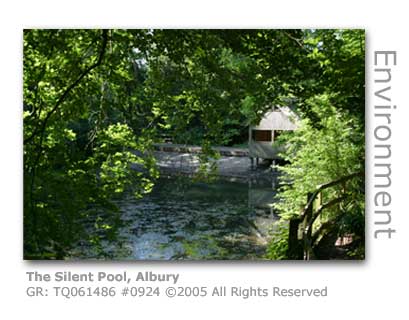
By 2008 marginal aquatic plants set in coir rolls have become established. Paths through the common have been surfaced with gravel and wooden bridges complete with handrails have been erected across ditches making the site easily accessible for accompanied disabled. Four stands have been erected for fishing alongside the pond. The work was contracted to a local specialist water remedial works company Land & Water Group Ltd based in Albury. There is unrestricted access to the site with public footpaths and tracks dissecting the site. Although there is no carpark on the common there is on-road parking on public roads nearby. Two miles outside of Guildford along the Shere Road (A25) are two ponds which are at the centre of a debate as to their origin. The Silent Pool (GR: TQ061486), which has local folklore and legends associated, and the adjoining Sherbourne Pond are considered a local beauty spot. The author Martin Tupper relates one of the legends in his novel Stephen Langton; or The Days of King John: A Romance of The Silent Pool published in 1858. The medieval King John is said to have encountered a woodsman's daughter bathing naked in the pool and in his attempts to entice the terrified girl out of the water she waded into deep water and drowned.
A joint team from the Surrey and Farnham Archaeological Societies has completed a survey (August 2006) to settle a 150 year old debate as to whether the ponds are a natural geological feature or were man-made in the 17th century. Findings suggest the southern half of The Silent Pool was excavated at the same time as the neighbouring Sherbourne Pond c1650. The northern part is of geological origin and clearly predates the 17th century excavation.. The current drought (2006), which has created severe difficulties for wildlife in and around the ponds, aided the survey team considerably as they were able to access the basin of The Silent Pool which has dried up completely.
Source: Operation Emma, named after Martin Tupper's heroine, has ruled out the chance that there was such a deep drop in the pool as to have led to her unfortunate demise. The survey did unearth important archaelogical evidence to support a history of the pool's construction.
Source: Fed by a spring Silent Pool was probably originally created as a fish pool but it has also been used for watercress beds and 'floated' water meadows. The lower Sherborne Pond was created in the 17th century specifically to provide a dependable water supply for the nearby village of Albury and to power a water turbine for grinding animal feed. The water was also used for an ornamental fountain and to irrigate vineyards. A separate spring feeds into Sherborne Pond and is much more reliable than the one the Silent Pool depends upon. The Old English name for the spring here was Shirburn, 'shirburn' meaning 'bright spring', and from whence Sherborne came. In more recent times the man-made dam between the two ponds has been reinforced with 15 ft (4.5 m) deep interlocking steel piling. The ponds have always been renowned for the clarity of their water but this had diminished considerably during the 1990s particularly in the lower pond so in 1999 Sherborne Pond was extensively dredged to remove large quantities of silt, and repair work was made to both dams to seal leaks that had developed. The clearness of the water returned, the clarity due to the close proximity of the ponds to the spring source. A boathouse was first built by the Silent Pool in Victorian times although this was demolished. The present building was built in 1996 by the Countryside Team of Surrey County Council. The Silent Pool itself has however been severely affected by the low rainfall of the last two years and at one point in the Spring of 2006 had completely dried up. Additional demands had been made on the watertable feeding the springs here by water extraction at Clandon to meet growing domestic water needs. However in the winter months (2006/7) water has flowed back into the pond and it has a good supply of the clear bluish chalk filtered water for which it is renowned. Much of this replenishment appears to be coming from sub-surface sources rather than the spring itself. Although the pond has suffered from low levels previously, especially in the droughts of 1976 and 1992, the last time it completely dried up for a long period was in 1741. Locals claim that a film scene was shot here featuring Sienna Miller who was filmed swimming naked in the pool. Hippie Hippie Shake is a British production and is based on the memoirs of Oz Magazine editor Richard Neville. The film was released in 2009. In the 1730s the renowned Venetian architect Giacomo Leoni was commissioned to design a grand Palladian mansion for the influential Onslow family, and he included the magnificent two storey Marble Hall as its focus. The hall was modeled by Italo-Swiss stuccoists with marble chimneypieces by Michael Rysbrack, a leading 18th century sculptor, and provides a stark colour contrast to the red brick of the exterior and rich colours of the state rooms beyond.
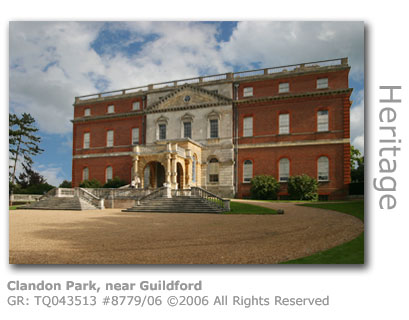
Situated just outside Guildford on the Epsom Road (A246) the house at Clandon Park (GR: TQ043513) has a collection of 18th century furniture, porcelain, textiles and carpets collected by Mrs Grubbay who owned the house in the 1920s. The property was bought by Sir Richard Onslow in 1641 and has been the home of the Onslow family ever since. Although the family no longer live in the existing great house, which was rebuilt in the 1720s by the 2nd Baron Onslow, the 7th Earl and his family live in a house in the park. The house and seven acres were donated to the National Trust in 1956. The 6th Earl had lost the fight to combat the rapidly escalating upkeep such a large property needed and sold the house to his aunt, the Countess of Iveagh who as a daughter of the 4th Earl had spent much of her childhood at Clandon Park. It was the Countess who eventually gifted the house to the Trust. National Trust staff were asked (2009) to nominate their favourite object housed in the building in which they worked. The following is the choice of an employee at Clandon Park:
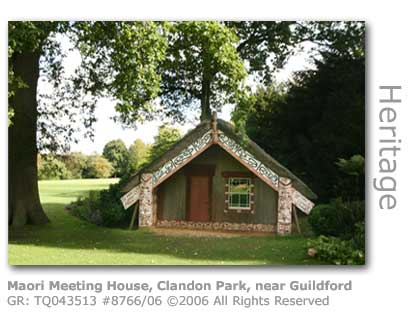
In the grounds are a parterre (1), grotto and a sunken Dutch garden. The outgoing governor of New Zealand, William Hillier the 4th Earl of Onslow, imported a traditional Maori meeting house in 1892 that he installed in the grounds here. (1) Parterre - an ornamental garden laid out in a formal pattern usually bordered by low evergreen hedges and filled with annual bedding plants. The building was one of only a few left intact after Mount Tarawere erupted in 1886 destroying the settlement and 100 of its inhabitants.
The meeting house, Hinemihi of the Old World, provided shelter for 50 survivors before the governor bought it for £50 and is only one of a handful of historic Maori meeting houses to be found outside New Zealand.
Schuster is a heritage advisor to New Zealand's Historic Places Trust and joined the conservation efforts of the University College of London's Institute of Archaeology in the restoration. Funding of £200,000 has been secured (June 2009) to restore the Maori meeting house. The restoration committee set up to oversee the project includes descendants of the house's original carvers, the UK-based Maori community and conservation experts from the National Trust and University College London. Plans being considered include extending the length of Hinemihi by one third to return it to its original size, using materials from New Zealand to replace the thatch roof and also refurbishing the 20 large carvings.
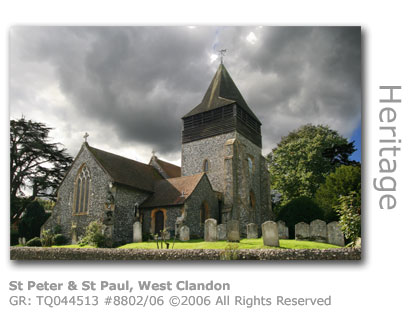
The Countess of Iveagh of the Onslow family presented the house and seven-acre gardens to the National Trust in 1956. The 7th Earl of Onslow lives in a house in the Park. The Queen's Royal Surrey Regiment Museum is based at Clandon Park. Sources: National Trust; Surrey Advertiser 29th September 2006 / 19th June 2009 Actors Keira Knightley and Ralph Fiennes were filmed in scenes for the new film The Duchess at Clandon House in August 2008. The magnificent marble hall doubled as a dining room and another scene was filmed in the saloon featuring a group of musicians playing. The Duchess tells the tale of an 18th century socialite and political campaigner Georgiana Duchess of Devonshire who was an ancestor of Diana, Princess of Wales. The scenes took four days to film. The manor of West Clandon, which also was variously referred to as Clandon Regis, has a long and distinguished history with it recorded in the Domesday Survey as being held by Edward of Salisbury but eventually was awarded to the Onslow family in 1711. The modern name of Clandon originates from the ancient English 'Clene Dune' which referred to the nature of the land this being downland clear of shrub. Apart from an upmarket pub, the Onslow Arms named in honour of the Onslow family and complete with a helicopter landing pad, the village's most notable building is the church of St Peter and St Paul (GR: TQ044513). The original building recorded in 1086, which was probably built by the Anglo Saxons in wood, was replaced during the Normans' ambitious 12th century campaign to replace and enlargen churches.
Records exist at the church from 1290 showing that Richard de Boclynton was the priest presiding at the time. It is thought that significant changes to the church starting with the chancel were funded by the Knights Templar circa 1220, the connection cemented by the fact that the local headquarters were at Temple Court, the current home of the Earl of Onslow within the parish. The unusual Purbeck marble font dates from 1150 and drains directly into the earth beneath the floor. A replica of an original wooden medieval carving which was stolen in modern times hangs over the North Door. This tells the story of local legend relating to a dragon that lived beyond the cottages opposite the church along Back Lane. One version of the legend tells of an army deserter who had been condemned to death, but having escaped was passing through the village when he heard about the dragon terrorising its inhabitants. In return for a promise of a pardon he slew the dragon with the help of his dog as depicted on the carving and accordingly was granted his freedom. On the North Wall are bread shelves believed to be unique beneath a benefaction board on which were placed sixpenny loaves for the poor and that were paid out of the estate of local businessman John Bone. This simple generosity came during a time of severe agricultural depression in the early 19th century.
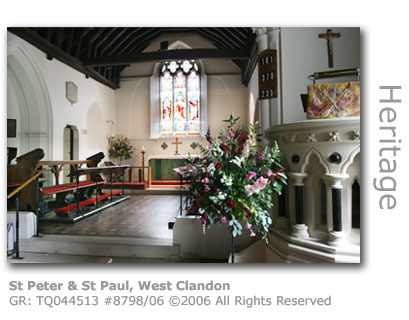
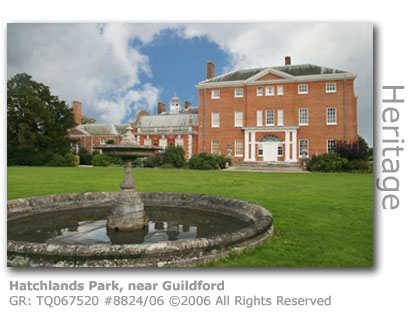
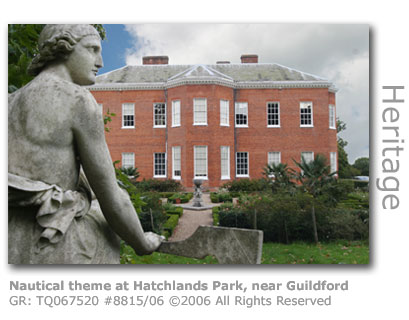
The current pulpit stands by a 12th century piscina of which there are very few of this style in Surrey. The pulpit as pictured above is of French stone and was installed in 1874 replacing the original Jacobean wooden pulpit. The original pews were provided with doors to keep out draughts but were replaced when gas heating was installed in 1874. There is a scratch dial high up on the outside of the South Wall. The dial consists of several concentric circles and when it had its gnomon (the sundial arm) in place was used as a crude way of indicating time and the times of services. The distinctive wooden clad spire was destroyed by fire in 1913 and had to be replaced. The heat was so intense that the six bells hanging in the belfry melted and had to be recast. Two more bells were added in 1932 to provide a peal of eight bells, unusual for such a small parish. Luckily the tower clock escaped damage from the fire which came as a relief to horologists as it has a rare mechanism. The clock, made by Thwaites and Reed of Clerkenwell in 1880, has a double three legged gravity escapement designed by a Mr Denison for the clock which strikes Big Ben in Westminster Tower. The mechanism separates the clockwork from the pendulum which is nine feet (2.7 m) long and is driven only by gravity which does not change with weather or friction in the clock. This makes for extreme accuracy. The original three three-quarter ton weights that had to be cranked to the top of the tower each week were replaced in 2004 with smaller weights wound automatically by electric motors. Situated 4 miles (6.4 km) outside of Guildford in East Clandon on the A246 road to Leatherhead, Hatchlands Park (GR: TQ067520) is an 18th century mansion set in 430 acres of parkland. The house has Adam interiors and claims the world's largest collection of keyboard instruments. Fine English, Italian, Flemish and Dutch paintings adorn the walls.
The first reference to an estate at Hatchlands was made in the Domesday book of 1086 when it was owned by the Abbey of Chertsey. In 1544 Henry VIII granted the estate to Sir Anthony Browne (d 1548) and his wife Elizabeth Fitzgerald ('The Fair Geraldine') (d 1589). Sir Anthony was Master of the Horse and Standard-Bearer to the king and became a personal friend. He stood in at Henry VIII's proxy marriage to Anne of Cleves in 1540 and during the king's final illness it was Sir Anthony that broke the news to the king of his terminal condition. Such was his standing he was appointed guardian to Prince Edward who was to become Edward VI and to Princess Elizabeth (later Elizabeth I). The interior designed by Robert Adams (1728 - 1792) is the earliest documented work he undertook of an English country house. Hatchlands Park was built by Admiral The Hon. Edward Boscawen, the third son of the 1st Viscount Falmouth. Boscawen was a naval hero of 18th century Britain and is remembered especially for the victory at the Battle of Louisburg in 1758, and for his destruction of a fleet off Lagos Bay, Portugal, in 1759.
A nautical theme runs through the house which replaced the old house that stood nearby. The admiral bought the estate circa 1750 and had Adams utilise designs incorporating anchors, cannon, dolphins and sea-nymphs. Neptune presides dominantly. The admiral did not have long to enjoy the new house dying as he did at the age of 49 in 1761. In the following century new owners including William Sumner of the East India Company undertook further changes to the interior which included gilding Adams' ceilings. The formal garden was designed by Gertrude Jekyll, and is set alongside the house and surrounded by a 430 acre park. Parkland of this size so close to London is remarkable and iillustrates the social and economic importance of the estate at the time.
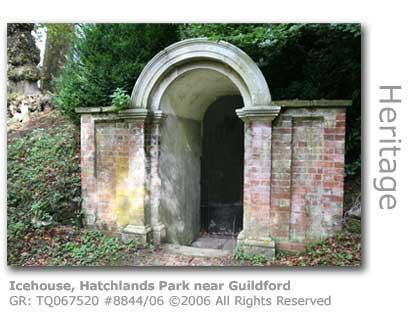
An icehouse sits discreetly near to the house. Icehouses were used before the luxury of refrigerators and freezers removed the need for ice to be gathered from nearby ponds and lakes and stored for use during the summer months. The Hatchlands' icehouse consists of a narrow passageway which was once sealed by a heavy door at each end. Beyond the inner door lay an eight foot (2.4 m) deep shaft cut into the ground and a high domed ceiling. The chalk bank into which Hatchlands' icehouse was cut allowed for ease of draining of meltwater. The estate and house was gifted the The National Trust in 1945 and is currently privately leased. The house and gardens are open to the public at restricted times. Hatchlands Park launched (April 2010) a new 'trampers' service at the house and estate. The service, which is limited to certain periods during the spring months, is making use of four-wheel-drive cross-country mobility vehicles that seat one person and which are on loan from the Disabled Ramblers Association. Hatchlands is one of 79 National Trust listed by Unilever's Bovril brand in their Great Outdoors Revival 2010. The initiative provides funding for a shortlist of projects voted in by the public. If Hatchlands is selected Unilever will provide funding for reinstating historic walks around the 430 acre Park taking in Bluebell woods, pastures and ponds. Winning projects will be announced in January 2011. A few miles to the south of Guildford lies Shalford, a village straddling the busy A281 Horsham Road with a population of 5,161 (2001). The village is recorded in the Domesday Book as having three watermills, and over the ensuing centuries there was much milling activity along both the rivers Wey and the Tilling Bourne which joins the Wey here (GR: SU996480) at a point along the southern edge of Shalford Park. The only surviving mill today is the National Trust owned 18th century Shalford Mill (GR: TQ001477) which takes its power from the Tilling Bourne. A mile or so further upstream (GR: SU997465) the Wey & Arun canal flows into the Wey near Broadford.
Historically Shalford is significant for its renowned medieval fair that operated on Shalford Common from the time of King John (1166 - 1216). The 'Great Fayre of Shalford' was granted a royal charter and grew to such popularity that at its peak it was recorded as covering 140 acres (570,000m2) and attracted merchants from much of the country. There is an unsubstantiated claim that the author John Bunyan (1628-1688) stayed for a time in the village and drew his inspiration for The Pilgrim's Progress from the fair. The fair was eventually eclipsed by St Catherine's fair on the other side of the river and died out.
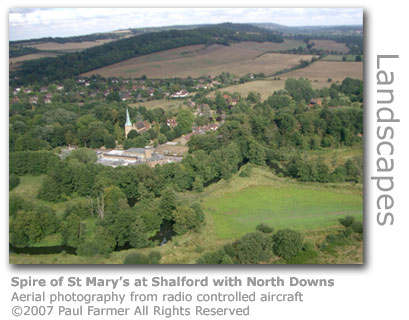
<><><><><><><> In 1877 a cricket match was played on the common when one side fielded 11 Mitchells, all related, against 11 Heaths all from the same family. The imposing parish church of St Mary's (GR: SU999478) was built in 1846 on the site of older churches dating from at least the 1086 Domesday Survey. A Tudor brass has been preserved here. There are a number of historic buildings in the village including Shalford House which dates back to the Tudor period (1485-1558) and has as a central feature of the dining room a carved stone fireplace that was installed in 1609. The house belonged to the Usten family for 300 years. Eight mature lime trees which were protected by a preservation order in 2005 are to be felled (February 2008). The trees, which are sited between St Mary's church and the Shalford Water Treatment Works, have been of concern to the parish council for some time as their size has resulted in damage to the church wall. A bat survey will be conducted before felling starts and the parish council has been charged with replacing the trees with younger specimens. A famous Shalford resident was Ernest Shepard, the artist who illustrated AA Milne's Winnie The Pooh books. Shepard stayed with his family at the vicarage before eventually moving to Shamley Green. He is said to have got the inspiration for his famous illustration of Christopher Robin peering down into the water from visits to nearby Shalford Mill. MORE ON SHEPARD HERE
In the late 19th century the government, concerned at the threat of invasion, implemented a plan to build a line of entrenched defences to be dug along the North Downs to protect London. These were to be manned by local volunteers gunners and riflemen and would serve as mobilisation centres stocked with ammunition and trenching tools. The westernmost centre was built at Henley Grove and Pewley Hill in Guildford with supplies being processed from a base at Nine Elms in London via a depot at Guildford Station. The forts were built in 1893 and had large earth banks and ditches excavated to protect the magazines and storerooms. Pewley Hill was the larger of the two, but with the entrenched defences line plan abandoned almost as soon as it had been implemented the properties were sold off in 19005. In 1940 during the Second World War the army constructed a considerable line of defences - the 'GHQ Stopline' to the south of London. Part of this included huge anti-tank ditches and large concrete pill boxes which can still be seen across the area today especially along the banks of the Wey and the Tilling Bourne. Guildford was never targeted by the Luftwaffe for attack although 542 air-raid alerts and 31 bombs were recorded here during the war, all considered to be the act of stray aircraft ditching their bomb loads having become lost. Eight Guildford residents lost their lives as a result. Guildford was however targeted by V1 flying bombs in an airborne campaign during the summer of 1944 and five landed on the town.
Following the increasing success of the German navy's submarine activity in disrupting supply convoys across the Atlantic food rationing had to be imposed in 1940. Books of vouchers were issued which gave weekly allowances for foods including meat, butter, tea, sugar and jam. The successful 'Dig for Victory' campaign saw virtually every piece of open ground dug up for vegetable plots and allotments were established for people without suitable gardens, with many of these still surviving today.
The population of Guildford was swollen by 8,000 during the Second World War when children were evacuated from London and vulnerable towns along the south coast. The allocation of evacuees receiving families was a lottery with many children experiencing unhappy stays.
Many pupils at the town's Royal Grammar School joined the Royal Air Force when they left school as they had a good reputation for science, and consequently the school saw more pupils lost during the Second War than the First. Largest losses were the aircrews in Bomber Command. The younger boys however delighted in aircraft spotting and were fascinated by dogfights between British and German aircraft.
Local historian Frank Phillipson, who has undertaken considerable research into Guildford during the war years, followed the last days of a young New Zealander who joined the RNZAF to serve Britain and the Commonwealth. Sgt Donald Law had only flown Spitfires for nine hours when he had a fatal crash at Slyfield Green, Guildford. In his last letter home the pilot spoke of his excitement at flying the air force's most powerful machine.
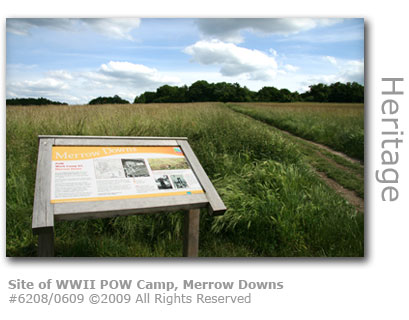
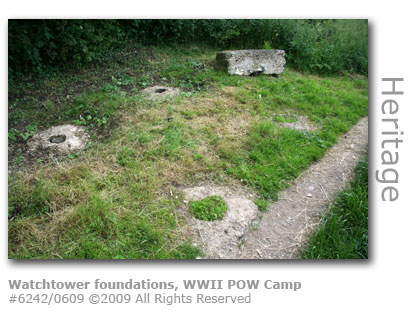
The lives of Guildford men and women who gave their lives during the war are recorded on the war memorial in the castle grounds. RECOLLECTION OF WARTIME RESIDENT In 1942 a Prisoner of War Camp (GR: TQ033501) was hastily erected on Merrow Down as Work Camp 57 adjacent to the Guildford Golf Club. The nearest watch tower was only a few yards away from the clubhouse door. By 1944 it housed close on 800 Italian prisoners sleeping 40 to a hut and absorbed from over 22,000 who had been captured in North Africa and who were regarded as low-risk. The Italian prisoners worked on local farms and forestry. It transpires that the camp was never to be upgraded during the war to a high-risk camp to house German prisoners due to its proximity to sensitive secret training camps.
As the war progressed the camp became pivotal to government plans to contain ever increasing numbers of POWs. Merrow Camp was a regional HQ administering another 14 POW camps and hostels across three counties responsible for 2,500 prisoners. Wanborough Manor (GR: SU935489) located six miles away on The Hog's Back had been converted into a Special Training School in 1941 by the Special Operations Executive (SOE) as the country's first centre of a national network for training wartime agents. It also acted as a debriefing and clearing centre for German POWs who had jumped sides, endearingly referred to as 'Bonzos', and who had just returned from SOE missions abroad for the Allies. Another SOE training centre at Tyting House (GR: TQ022487) by St Martha's Hill near Guildford housed a highly sensitive Security Section. The house had been requisitioned in 1942 by the Special Operations Executive and was designated as Special Training School 28 where agents assigned for covert operations in enemy territory were appraised. Later it was used for processing agents returning from operations and was where they were accommodated until they could be returned to normal life once it was deemed that they no longer presented a threat to those agents still in the field. Tyting House was converted into council flats after the war, but having later fallen into disrepair was demolished in 1957. Tyting Farm, originally part of the estate, remains today and is currently leased to the Surrey Wildlife Trust. MORE HERE
The Merrow Camp however did at the close of the war take in German prisoners after the Italian inmates were released for repatriation or despatch to open hostels. Among the first were a small group of German prisoners who were to act in administration and liaison roles with responsibility for 15 satellite camps and hostels in West Surrey scattered between Shamley Green, Ewhurst and Shackleford. They were to be joined by German POWs shipped back to Europe from North America in 1946. The camp commander had a difficult time quelling deep unrest as the prisoners from across the Atlantic had been told prior to departure that they were being repatriated straight to Germany, and the Guildford facilities were inferior to those they had become accustomed to. Gradually restrictions on prisoners were relaxed and it was not uncommon to encounter them roaming unescorted about the town. The local community also softened their hostility and many were welcomed into local homes and attended the church in Merrow for services. Groups of prisoners as part of their rehabilitation were also invited to the Houses of Parliament and some took up studies at Guildford Technical College. One German prisoner of war who was held at Merrow in 1947 decided to make Britain his home when he was finally released and was granted British citizenship. Gerhard Breitenfeld was assigned work on the local sewerage system whilst at the camp and found the post-war regime for Germans awaiting repatriation very relaxed.
Breitenfeld, having heard that his family farm in Germany had become absorbed into Poland and seized, decided to pursue the chance of settling in England.
Once the camp finally closed as a POW centre in 1948 it provided emergency housing with weekly rent of 12s (60p) for a partioned half-hut. The camp was permanently closed in 1958 with some of the remaining residents being housed in the newly-completed Bushy Hill estate in Guildford. All that remains today are some of the camp terraces and hut footings on the golf club's practice driving grounds. The tarmac road remaining there was the approach road to the prison compound, and alongside was where the guard huts, administration buildings and stores had been located. Source:
Military historian John Glanfield continues to research the Merrow camp and with input from readers of local paper the Surrey Advertiser has unearthed more fascinating facts. The story of an encounter with an Italian POW by a local jobbing gardener highlights how Major Yates, the camp commander, treated his prisoners, especially those with rank. Cycling home Harry Woods almost came off his bike in shock when confronted with the sight of the enemy officer in full uniform standing at the side of the road chatting nonchantly to a woman. Enquiries by the police revealed that the major was regularly letting the Italian medical officer out on parole on the understanding that he would not travel further than a mile from the camp, nor attempt to escape, visit local shops and houses, or post mail. The police also discovered that the War Office had authorised parole for italian medical officers and chaplains, but had forgotten to advise the local police. Prisoners lived in concrete-floored huts that slept 40 in two-tier bunks. The huts' wooden walls were loosely insulated with bitumenised felt and prisoners were issued with straw mattresses and three blankets, with a fourth available in winter months. Each hut had a solid-fuel iron stove and electric light, with latrines and ablutions provided in communal blocks. The prisoners' senior officer, Secondo-Capo (a naval rank of Second Chief) Luigi Angelini had responsibility for his men's discipline and welfare. Reveille was at 6.30 am, although the men had an extra hour in bed on Sundays, and they started the day on a breakfast of bread, jam and a hot beverage loosely described as 'coffee'. They were then transported to the farms and sawmills to fulfil an eight-hour day, six days each week, where they would break for a typical meal of bread, cheese, potato puree and coffee. The men's early evening meal usually included meat, bread, vegetable soup or fruit, with a dessert and glass of beer on Sundays. The POWs were subject to the same rationing restrictions as the local populace, but were allowed a monthly issue of 2lbs (0.9kg) of macaroni a month. They also had a weekly ration of 35 cigarettes or 11/4oz (35g) of tobacco and 4oz (113g) of soap. The prisoners were paid three farthings (15p at 2007 values) per hour for unskilled labour, and a penny ha'penny (90p) for skilled work, all paid in tokens redeemable in the camp's canteen. There they could buy smoking accessories, basic toiletries, aspirin and liver pills, stationery, Oxo, Bovril, lemonade powder, and a variety of local produce to supplement their diets. Profits from the canteen were donated to a prisoner's welfare fund. Although it was strictly against the camp's regulations, inmates with woodworking and metalworking skills would craft souvenirs, often using materials salvaged from downed aircraft, and sell them locally for hard currency. The prisoners had use of musical instruments and held regular concerts. There was no official restriction on what songs were sung with the exception of Giovinezza, the unofficial national anthem of Italy at the time. There were few recorded escapes from Merrow, and those that did were recaptured. Two Italian POWs in a 1942 attempt managed only to reach Leatherhaed in Surrey before being apprehended. The Merrow Camp was deemed to be in too sensitive a location to house high-risk German prisoners, especially with the Special Operations Executive's Tyting House and Wanborough Manor being nearby. The authorities in 1944 were desperate to move German prisoners from France to England and had earmarked 24 camps in Britain, including Merrow, to be emptied. In the event Merrow Camp itself was to wait until the war was over. 458 German POWs were consigned in September 1945 to satellite hostels under Merrow's responsibility. Locally 220 went to The Hallams (1) (GR: TQ038452) near Blackheath and a further 144 to huts in Shackleford near Godalming. In June 1946 Merrow Camp was cleared of Italians and filled with Germans who had been held in North America during the war. By this time The Hallams was holding over 400 prisoners. (1) The Hallams is a Grade II listed country house built in Victorian style by the architect Norman Shaw in 1894. The house has 13 bedrooms and was valued in 2007 at £2,250,000. Towards the end of the year regulations were relaxed for prisoners not deemed to be a threat and a third of the 720 Germans held in Merrow Camp were released to billets on local farms. By Christmas, 500 from across the satellite hostels had been repatriated.
The easing of controls on the POWs is illustrated by stories gathered by historian John Glanfield. These include prisoners attending courses at Guildford Technical College, Woolworths' 3d and 6d store in town becoming a popular destination, and a young German soldier whispering a translation of the service in Merrow's St John Church to his compatriots huddled in the pews. The German's own pastor gave a heartfelt address at the church on Boxing Day to thank the people of Merrow for inviting prisoners to join them in their homes for Christmas. One German, who was to remain in England after the war to rebuild his life recounted how, as a 19 year old prisoner, he found Merrow lightly guarded with the pisoners virtually running the camp themselves. The watch towers had all but been abandoned and holes had been cut in the barbed wire, not for escape but to make getting in and out easier. The last truckload of Germans left Merrow in April 1948. This letter, written by the departing Camp Leader 28 year old Feldwebel (sergeant) Willi Helmdach, was published in the Surrey Advertiser.
Today the only evidence remaining of the camp at Merrow are the large tree-fringed terrace cut into the hillside by the prisoners and used as a football pitch, the short tarmac road that led to the wire-fenced compound, and the concrete bases of three of the four corner watch towers. Some hut footings are still also clearly visible. Source: In May 2008 the 60th anniversary of the closure of Merrow Camp 57 was marked with a ceremony to unveil two information panels on the site. The prominence today of the historical importance of the camp is largely down to extensive research by John Glanfield, the military historian and author. The Surrey Advertiser publishes a weekly archive on local history edited by David Rose. Burwood Farm (GR: TQ020493) on Merrow Downs had their 40 Acre Field which proved to be a useful aviation facility for pilot training and touring air displays. During the 1930s a flying circus used the field as a base for local displays, with one recorded in the area in 1935. In the Second World War the RAF used the field as a relief landing ground to take overspill from Fairoaks airfield near Chobham 12 miles away. The No. 18 Elementary Flying Training School (EFTS) based at Fairoaks, which had been formed in 1937 by General Aircraft Ltd and taken over by the RAF at outbreak of war, operated DeHavilland Tiger Moths from Merrow. A particular activity favoured here was the practising of forced landings. Between 1943 and 1944 the field was used as a temporary base for three RAF Taylorcraft Auster aircraft, light single-engined monoplanes used for artillery spotting. As there were no permanent facilities at Merrow any personnel based there for a time had to resort to tented accommodation. In 1940 a radio tender was positioned at nearby Newlands Corner to boost the high-frequency radio signals passing between fighter aircraft and their Fighter Command Sector Stations.
A number of flying incidents related to the field were recorded during the war, perhaps not surprising given the function the field served. In 1941 a Bristol Blenheim made a forced landing due to bad weather and on the following day the relief crew were brought in by light aircraft to recover the plane. Unfortunately the pilot of the relief aircraft, an Avro Anson, was unable to gain sufficient height when attempting take-off and crashed the aircraft into the outbuildings of a house on the perimeter of the field. Thankfully there were no casualties, although the plane was written off. The crew of the Blenheim having witnessed the accident reportedly decided against attempting to fly the bomber out and it was later dismantled and transported by road. In the same year a Tiger Moth of No. 18 EFTS had to make an emergency landing in the woods at Newlands Corner after a fuel fault caused a loss of power. The aircraft was recovered. In 1943 an Australian trainee pilot crashed his Tiger Moth into the trees at the edge of the Merrow field having overshot on landing. No serious injuries were sustained by either the pilot or his instructor, although the plane overturned and was written off. Source: SEE ALSO USAF AIRCRASH AT JACOBSWELL Guildford Pre-war Air Displays Stoke Park in Guildford provided the landing strip for airshows demonstrating the latest in aviation technology in the 1920s and 30s. Displays were also staged over Newlands Corner, West Clandon and the meadowlands by the River Wey, near Guildford Lido where the A3 bypass and Premier Inn Hotel currently stand. The Cornwall Aviation Company in the summer of 1926 offered members of the public with joyrides in aircraft including the Avro 504K for five shillings (25p equivalent today). Braver souls could for 15 shillings (75p) experience aerobatics including a loop-the-loop as the following account written by a Surrey Advertiser reporter at the time testified.
A display over the meadowlands by the Sky Devils Air Circus in 1934 provided the Mayor of Guildford, W. G. Sheppard, who enjoyed a flight over the town in an Imperial Airways Armstrong Whitworth Argosy airliner, with an opportunity to air his eagerness to establish an airport at Guildford. The show raised funds for the local Queens Nursing Association. David Rose, editor of the Surrey Advertiser's weekly feature From The Archives, unearthed an article published in The Aeroplane magazine in 1934, describing a display held over Sussex Farm in West London in April of the same year. The display included formation flights as well as aerobatic displays, an air race, parachute jumps and joyrides to be enjoyed by the public. A daring attempt to demonstrate the manoeuvrability of an autogyro was aborted when the machine collided on takeoff with a corrugated iron dummy fort that was to be used as a bombing target. The autogyro's rotor blades were knocked off and its undercarriage was damaged. No mention was made of the welfare of the pilot. The second-ever recorded attempt to broadcast a commentary to the ground from an aircraft during an aerobatic display was also conducted at the show, although this was noted to be only moderately successful. The same pilot, one Flight Lt Tyson, also flew a Tiger Moth upside down right over the crowd at a height of 20 feet according to the magazine - a stunt that would certainly be disallowed today! These public displays were not without tragedy. A Miles Hawk two-seater monoplane that had been undertaking practice flights prior to the start of the Coronation Air Display Carnival in the summer of 1937 collided with an elderly man when it was coming in to land at Stoke Park. Charles Puttock, an 80-year-old Guildford resident who had for many years worked as a blacksmith operating a forge by the Anchor and Horseshoes pub in London Road, tragically died of his injuries. A report in the Surrey Advertiser noted that Puttock was cutting across the park whilst walking to the pub when he was struck by the aircraft which had landed without authority. Source: During the Second World War the Ministry of Food issued a directive for the establishment of communal kitchens where every citizen could go to obtain at least one wholesome cooked meal per day. Britain had relied on the importation of 55 million tons of food from abroad immediately prior to the outbreak of hostilities and with these supplies being severely disrupted harsh food rationing was introduced. The government strategic food policy at the time determined that an adult could live healthily on a diet of twelve ounces of bread, six ounces of vegetables, a pound of potatoes, two ounces of oatmeal, an ounce of fat, and six-tenths of a pint of milk per day, supplemented either by small amounts of cheese, pulses, meat, fish, sugar, eggs and dried fruit. Food prices were fixed by the government to prevent racketeering. The British Restaurant system allowed citizens to eat there without having to give up precious rationing coupons. The first British Restaurants to open in Guildford were in October 1940 when the Mission Church Hall in Westborough and Stoughton Church Room opened their doors to the needy. Others opened over the ensuing years which included Upper High Street in Guildford centre; Addison Road, Charlotteville; and Merrow Village Hall. Angel Yard off the High Street in nearby Godalming also housed a British Restaurant. Meal tickets were issued that took the form of coloured cellulose acetate tokens in the shape of large coins and these were presented in exchange for a subsidised meal. Typically a meal would consist of soup, roast beef with Yorkshire pudding, potatoes and cabbage, with apple pie and custard and a cup of tea which would cost one shilling (5p equivalent today). The tokens were issued in the restaurant in return for cash with individual colours denoting the meal courses and beverages the diner had chosen. The restaurants run by the council and supported by organisations including the WRVS (1) were large enough to seat from 150 (Mission Hall, Guildford) to 600 (Upper High Street, Guildford) diners for lunchtime sittings. The Godalming Museum houses an original token dispenser and tokens. Sources: www.war-experience.org; Surrey Advertiser 29th September 2006 The Foxenden Quarry As the intensity of German air raids in WWII started to increase so did the need for shelter provision for the local population. A perfect site for a mass shelter was identified by the Borough Council's Emergency Committee at a disused chalk quarry (GR: SU999498) close to the town centre. The deep shelter, which could accommodate 1,000 people, was dug into the upper strata of the chalk and consisted of a series of interconnecting tunnels equipped with bunks, ventilation, sanitation and first aid stations. The tunneling and construction took a year to complete.
The shelter was closed down in 1944 and in the ensuing decades was used by the local council for storage. The tunnels were cleared in the 1980s when restorative work had to be undertaken to prevent deterioration and collapse. The complex was completely sealed a decade ago when a child fell into a tunnel having managed to climb through an emergency hatch. The child tragically suffered fatal injuries. Sealed from public view for 60 years the shelter has survived pretty much intact and has only recently been opened to limited visits. Many of the original features including signs and toilets have been preserved. The only dominant feature missing are the bunks which were removed after the war. The shelter, which is accessed through a secure entrance at York Road car park, is now opened to the public once a year to celebrate UK Heritage Days in September. Information from the Tourist Information Centre in Tunsgate, Guildford. A total of 18 public shelters were created in Guildford which included those beneath the Playhouse off the High Street, the Angel Hotel's crypt, the public baths in Castle Street and one located at Guildford Glass Works in Portsmouth Road. TAKE A PHOTOTOUR The result of research conducted by Guildford Museum alongside an oral history project has revealed the extent that Guildford played in the war in providing a safe haven for evacuees from London. Matthew Alexander, who recently retired from the museum, wrote a feature on the subject for the Surrey Advertiser (24th July 2009). The Guildford area was regarded as an unlikely target for German bombers and so plans were drawn up to evacuate up to 10,600 London children here as early as 1939, with some evacuations under Operation Pied Piper taking place two days before the outbreak of war. The evacuation of children was voluntary and was organised by their London schools. The children were received at evacuation camps at Sheephatch in Tilford, Marchant's Hill in Hindhead, Godalming, and Sayers Croft in Ewhurst. Once the children had arrived by train they were transported in buses to distributing centres which were managed by a registration officer, a headteacher and an assistant. The Women's Voluntary Service (WVS) assisted by teachers and girl guides provided refreshments prior to the children being sent out in batches for billeting at local homes. The billeting officers tried wherever possible to accommodate the children in pairs.
In the event the first evacuation proved relatively short lived as by January 1940 many of the children had returned to London. The main reasons were that none of the predicted air raids on London had occurred, many of the children were complaining of homesickness, and the cost for many London parents of travelling to visit their children was becoming prohibitive. After the fall of France in May 1940 many new evacuees were received in the Guildford area travelling from Portsmouth, Shoreham and Brighton because of the threat of German invasion. The start of the London Blitz on September 7th 1940 saw even more children evacuated. Guildford's population increased by nearly 8,000 during the first three years of the war, with much of this increase due to the influx of evacuees. The remaining numbers were made up by adult employees of companies moving out of London to avoid the bombing.
Initially there were considerable problems due to the fact that all of Guildford's schools were closed until air raid shelters could be built. One of these still remains in the playground of the former Holy Trinity and St Mary's School beneath Pewley Hill. Once the schools were reopened the teaching staff had to contend with dramatically increased class sizes and the pressure of having to cope with extra work due to younger teachers leaving to join the armed forces. Not all evacuees were well received and records show that refusal to receive the children who were regarded as troublemakers was responded to by official threats of prosecution.
The evacuation was not officially ended until March 1946, although by the summer of 1945 many evacuees had elected to return home. By the end of the war records show that at least 4,500 London children were given safe haven in the Guildford area. Source: Six of the original evacuees who were accommodated in Shamley Green at the outbreak of the Second World War joined in a re-enactment of the evacuation (September 2009) along with 200 children from two of the london schools that were involved. Pupils from Beatrix Potter School and Swaffield School in Wandsworth, London travelled down by train to Shalford Station on a nine coach train hauled by a Battle of Britain class steam locomotive, the Tangmere. The children carried gas mask cases and wore labels with their names on, and along with their teachers wore period clothing. They were met by youngsters from local infant schools to enjoy afternoon of activities and games. A re-enactment group, On Parade, added to the atmosphere providing military personnel, a village policeman, ARP warden and Micky the Fish played the part of the ubiquitous spiv. The visitors toured old billet houses, the village school, and the old chapel and Arbuthnot Hall which were both used as schoolrooms during the war. Two of the former evacuees, Frank Witham and Pam Jones who were nine and eight years old respectively at the time, found that the visit brought back a lot of memories.
Jones remembers taking turns with her brother to pump the church organ for services for Canadian soldiers. Another evacuee James McEntee moved from Worcester with his mother to live with his grandparents in Shamley Green after his father went after the war. He now lives in Bramley.
Source: Wey Valley's Leading Hospital Threatened with Closure IT'S OFFICIAL - ROYAL SURREY SAVED (August 2007) The Royal Surrey Hospital in Guildford which provides major in-patient and out-patient services for the county, including accident and emergency services, is facing the possibility of closure as part of the government's attempt to slash £100m from the county's NHS spending.
A campaign to save the hospital has been launched by an eminent surgeon with the backing of two Surrey MPs. The threat comes as news leaked that the NHS were considering closing either the Royal Surrey or St Peters Hospital in Chertsey. Another option being considered is the merging of the two trusts.
The Independent Campaign to Save the Royal Surrey County Hospital held its first public meeting (October 2006) outlining its concerns. The first consultations concerning the issue are being held by the NHS in December which has instilled a mood of urgency over getting public reaction out into the open.
A local paramedic with over two decades of service in saving lives in the county had already started issuing petition forms of his own volition fearful that closure of the accident and emergency facilities could lead to loss of life.
More information and details on how you can get involved are available at the Royal Surrey Action Group. British residents can also sign the official online petition to be submitted to Downing Street HERE Sources:
The leader of the opposition David Cameron during a visit to the Royal Surrey (February 2007) took the opportunity to lambast the government over their planned cuts to the health service in Surrey.
Source: The Good Life star Penelope Keith has joined the fight to save the hospital and highlighted the longer travel times closure would impose by traveling by bus (February 2007) to make the point. Ms Keith CBE lives in Milford near Godalming. IT'S OFFICIAL - ROYAL SURREY SAVED Surrey Primary Care Trust announced (August 2007) that the threat to axe key services at Guildford's Royal Surrey Hospital has been withdrawn. There are still further stages to negotiate in the NHS services review including approval by the South East Coast Strategic Health Authority.
Source: University of Surrey Linguists The Surrey Morphology Group, who are based at Surrey University in Guildford, is a team of linguists who have set themselves the task of recording and analysing the world's rarest and most rapidly disappearing languages for posterity. Founded in 1992 the group have an unenviable task given that there are 6,000 native languages in the 193 countries of the world with many of these in danger of losing their hold in the face of increasing globalisation. The overall aim is to investigate why the global population speaks so many different languages and dialects and what it says about cultures, histories and human psychology.
As an example a member of the group went to Bougainville in the South Pacific and recorded a language that would otherwise have died without being heard by western ears. Torau is spoken by only 1,000 people where locally there are at least 25 other languages many related in some way to western languages such as English, German and Russian. The group have worked on languages with just 30 to 40 speakers, and one that had only one surviving speaker. Linguists fear that between 45% and 90% of languages will disappear over the next 50 years. Source: Stringer's & Chitty's Commons Regeneration The 13 acres of Chitty's Common (GR: SU978522), wedged between the housing estates of Stoughton and Rydes Hill close to the Worplesdon Road (A322), are to be restored thanks to a prize award from a savings bank. The Surrey Wildlife Trust beat off competition in a public ballot (November 2006) to nominate an area that needed restoration for The Sanctuary Awards. The common, with a diverse range of habitats including three ponds and mixed woodland, will benefit from the £10,000 prize awarded by ING Direct. General clearance including felling of trees will open the common up to more light, and with the construction of a pathway around the main pond will make the common much more accessible to local residents.
The project, which is scheduled to start in January 2007, is expected to take to the end of the year to complete. Source: Half a mile away on Stringer's Common by Bellfields and Jacobswell is Britten's Pond (GR: SU992531), a Site of Special Scientific Interest (SSSI), which is being given a new lease of life after consent was given (July 2006) for the Surrey Wildlife Trust to undertake works on the pond and its surrounds. Defra gave the thumbs up for the Trust to dredge 2,500 cm of silt from the pond and to create a new inlet pond to act as a silt catchment which could be cleared regularly. They also intend to establish reed beds to benefit wildlife and stabilise the pond's banks. The pond forms part of the natural drainage system in the area and is an integral part of flood control for Jacobswell downstream. The pond is popular with fisherman who will benefit from the improved conditions for the pond's fish stocks. Both English Nature and The Open Spaces Society are supporting the Trust's activities. The common itself benefited from a community clean-up in September 2006 led by two local police community support officers. The volunteers removed a lorry load of rubbish including old bicycles and motorcycles, chairs, garden tools, lawn mowers, toys, mattresses and assorted car parts that had all been dumped illegally. Stringer's Common is owned by Surrey County Council and managed by the Surrey Wildlife Trust. Since then the trust and its volunteers have improved flood defences at Britten's Pond and have provided easier access for disabled people who are now not only able to move around the area with ease but can also fish at the pond. The Guildford Angling Society with support from the Environment Agency have been improving conditions at the pond to improve it as a fishery. Sixty volunteers from the trust's corporate partner Eli Lilly took to the pond (May 2009) to improve the wildlife habitat. Protective netting was installed over new plant growth to deter geese, coir netting was installed along sections of the bank to encourage the spread of plant growth, and niches were carved along the banks to attract insects such as wasps, mason bees and bumble bees.
Stringer's Common attracted national media attention in 1997 when campaigners set up several anti-road protest camps to object to the widening of the A320 Woking Road which needed to encroach upon the common. The council's plans were eventually shelved. Historian Frank Phillipson successfully launched a fund (June 2009) with Surrey Advertiser archives editor David Rose to erect a plaque near the site of a wartime aircraft accident in Jacobswell on the northern outskirts of Guildford. A C47 Skytrain flown by USAF pilot Lt Mercer Avent had taken off from the airfield at Greenham Common in October 1944 when it encountered low cloud over the North Downs near Guildford. The pilot sensing danger as the Lilly Bell II approached the hills spotted a gap in the clouds and put the aircraft into a steep climb. Unfortunately the aircraft either stalled, or its precious cargo of signalling equipment destined for northern France suddenly shifted to the rear of the fuselage, and the plane came down in a field alongside Clay Lane in Jacobswell with the loss of all four crew members. The stone mounted aluminium plaque is to be sited at the junction of Clay Lane and Queenhythe Road. Some of the metallic items since found at the crash scene are to be melted down and included within the plaque. After donations from members of the public and organisations including BAe Systems, Chambers and Worplesdon Parish Council the plaque is to be unveiled on the site in October 2010. MORE ON WARTIME GUILDFORD HERE Seven-mile Wide Gas Reservoir Plans are afoot to explore the possibility of storing natural gas in a gas field 2,000 feet (610 m) beneath Albury near Guildford. The Albury gas field is a natural seven-mile (11 km) wide reservoir contained within a sand strata that provides a perfect storage basin and would be reached by drilling from an existing gas facility in Albury Park. The Hampshire-based energy company, Star Energy, says that there are very few onshore porous gas reservoir sites in the UK, the others being two located in Lincolnshire and another in Bletchingley in Surrey. Currently the facility at Albury Park covers four acres, although it is estimated that drilling and servicing the new gas storage reservoir will need a land area of 10 acres for access and equipment. A pipeline would need to be dug across the countryside to connect the gas storage facilities to the main grid in East Horsley. The gas field stretches seven miles from Albury west to Shalford. Albury Parish Council are objecting to the proposal on grounds of unacceptable noise pollution during drilling and access problems to the site by road. Source: It looks likely (May 2007) that Star Energy, the company behind the proposed reservoir, is now actively considering a site near Ripley as an alternative to the Albury location. The new site is located about 800m east of Send Prison, and will connect to the existing Albury facilities which are estimated to need to increase by a further 0.2 hectares to accommodate the new link. Source: Park Rangers are Unsung Heroes Working in shifts Guildford's park rangers undertake invaluable work in ensuring that the 83 parks under the care of Guildford Borough Council are maintained both for the park's visitors and their resident and visiting wildlife. With their watching brief covering all of the borough's green spaces, from the pocket-sized Quakers Acre by Guildford Library and the castle grounds, to the large open spaces of Millmead, Riverside, Shalford Park and Stoke Park, the team of rangers don't just concentrate on park upkeep. Regular rough sleepers use the town's open spaces and the rangers will keep an eye open for them to check on their welfare, liaising with outreach workers, the police and community safety wardens.
The shift system allows the parks to be patrolled from early morning to late at night helping to ensure that visitors are safe in the knowledge that their welfare and that of these invaluable open spaces is ensured. Source: Guildford Gospel The close of the 2007 Guildford International Music Festival, which was held at various venues across the town for two weeks in March, was marked by the performance of a specially commissioned song entitled Guildford Gospel immortalising a collection of oral histories associated with the town. Written by Basil Meade, director of the London Community Gospel Choir, the song was performed before an audience of 600 people at Guildford Cathedral.
The festival was established in 1991 to bring international artists, young artists and new music across all genres to a local stage, and provide some prominence also for local music organisations. The next festival in 2009 will mark the event's 10th anniversary. Source: An Uncertain Future In October 2006 the 115 acre Tyting Farm (TQ023487) in Halfpenny Lane at the base of St Martha's Hill was leased by Guildford Borough Council to the Surrey Wildlife Trust who wanted to save the deserted farm from dereliction. [but see below as deal eventually fell through] Local groups celebrated the news having successfully campaigned to persuade the local council from selling the farm fearing that it may fall into the hands of property developers. The Trust is working in conjunction with the HALOW Project, which works to provide young adults with learning difficulties to create a better quality of life and for which the farm will provide an ideal focus.
The farm had been unworked since June 2005 and had had an uncertain future. The Trust has since been working hard to bring the farm back into production, with the introduction (May 2007) of a 20-strong herd of cows and calves in conjunction with a local cattle farmer marking the first step in the farm's recovery. The Trust has secured much of the farm's field boundaries and is undertaking conservation work The Halow Project will utilise funds raised through OilAid (1) to build an accommodation and training facility for young people with special needs who will work on the farm.
(1) OilAid was founded in the aftermath of the 2004 Tsunami by executives in the Shipping Industry who had lost friends and family. Launched in 2005 the charity raises funds to help improve people's lives by fund-raising seven-a-side football tournaments. Sources: The deal to lease Tyting Farm however eventually fell through in 2007 due to a dispute with the council over the length of the agreement. The farm was put up for rent in January 2009, three years after a successful campaign to prevent the council from dividing the land into a series of plots with a view to selling to private buyers. The plight of the abandoned Tyting Farm was highlighted by Guildford Borough Council’s attempts at removing a group of squatters who had moved onto the site in April 2009. A second attempt by the council in the following month failed when the County Court judge presiding ruled that the paperwork necessary to secure an interim Possession Order was deficient. This deficiency included the inability of the council to present the deeds to the farm as evidence of ownership. The squatters in court told the judge that they were intending to formally submit a proposal to the council for converting the farm into a sustainable community project.
David Shayler, the former MI5 whistleblower, has joined with the squatters at the site, together with a spiritual group called the Rainbow Gathering and environmental activists The Circle Community.
Source: A handful of squatters remained in the grounds of the farm having been evicted from the buildings after the interim possession order (IPO) was served (May 2009). They face arrest if they re-enter the property. A full possession order was granted (June 2009) at Guildford County Court amid disruptive scenes. One of the squatters interrupted the proceedings claiming "I am the Lord Jesus Christ and I take whole authority in the law. If you do not recognise that, I will take action for perjury. I’m the Lord Jesus Christ and you are not. You are a judge." The bailiffs appointed by the council now have full authority to remove the squatters, although members of the group still insist that they will return. They have formed the Tyting Farm Community which wants to turn the 118-acre site into a sustainable farm project.
Source: Guildford Borough Council revealed (August 2009) that it spent a total of £34,049 in its eventually succesful attempt at evicting the squatters. The bulk of taxpayers' cash was spent on security (£27,603) with £3,283 paid to bailiffs involved in the final eviction, and £2.054 on re-boarding the farmhouse after the squatters were evicted. A former Guildford poor house, Guildford Union Workhouse, was restored in part by the Charlotteville Jubilee Trust (1) after receiving a £1.19m grant from the Heritage Lottery Fund. The renovated building, which is believed to be the most complete surviving example of the 500 vagrant or 'casual' (2) wards built by the Victorians and Edwardians, is only one of two in the country open to the public. The wards were established under the 1834 Poor Law in order to keep vagrants off the streets by providing them with hostel accommodation. The wards were built as confined spaces to separate out the vagrants from the usual occupants of the workhouse as they were regarded as being obstructive to the organised regimes imposed to maintain discipline. The vagrants at the time were described as being "filthy, crude and coarse, regularly in gangs, they drank, fought, cussed and swore”. The Guildford Spike, which was built in 1905 to the designs of architect E Lunn who had designed the workhouse main buildings, has the original cast-iron grills still in place through which inmates fed flints and stones they had broken up with hammers to the street. The stones were used for repairing roads, and this system of feeding them through a grill ensured that the stones were broken down to the correct size. The Spike was deliberately sited on the edge of the complex to provide as much distance as possible from the main workhouse building. The Heritage Lottery Fund has provided (2007) a further grant to fund for two years a part-time education and outreach officer who will provide visitors with informative guided tours. The initiative is intended primarily to provide primary school children with an introduction to how society once viewed the poor and destitute and how harshly they were treated before the concept of a welfare state was introduced. The ward regimes were tough and were designed to discourage people from dropping to such a low level in society. They were deliberately intended to provide facilities that were "worse than the conditions of the lowest farm labourer" and the Guildford Spike didn't even provide beds. Inmates were issued with a single blanket and had to sleep on the floor, two to a 8' x 4'6" (2.4m x 1.4m) cell. In return for their keep vagrants had to work on assigned tasks. These included oakum production (3), rug and carpet beating, stone breaking, log chopping and corn grinding.
George Orwell recounted his own personal experiences of staying in Spikes in his first published work Down and Out in Paris and London (1933). The vivid and sensitive account of how the poor were treated by society shocked the middle-class establishment. The Guildford Spike became history after the Unemployment Act of 1937 was passed to provide help for the huge numbers of unemployed between the First and Second World Wars. The building did however continue to provide more relaxed hostel facilities for casual workers and vagrants into the 1960s. In the 1930s the Guildford Union Workhouse site was absorbed into the hospital that had shared the site since 1870. The hospital was to become St Lukes and The Spike was used for a time variously as record storage, offices and a maintenance workshop. The wards became known as 'spikes' after the tool used in one of the core work tasks undertaken there. (1) The Charlotteville Jubilee Trust was established in 2002 to provide residents of Charlotteville in Guildford with an improved environment. Charlotteville was built in the 1870s and was one of the first suburbs of Guildford. Source: Slyfield & Normandy New homes built on former council-owned land in Slyfield, Guildford have been given (July 2007) the accolade of an 'excellent' BRE EcoHomes (1) rating. The new environmentally friendly housing scheme in Waterside Road provides three large family homes for local Guildford Homechoice (2) tenants. The homes were designed to ensure low fuel bills and reduced CO2 emissions. Special features include solar water heating, high levels of insulation and a heat recovery system that eliminates the need for central heating in upstairs rooms. Guildford Borough Council provided the land and provided £283,000 towards the build, roughly one-third of the cost of the development.
The Slyfield development is one of only 20 schemes in the South east to receive the EcoHomes Excellent rating. In nearby Normandy the Greenoak Housing Association has been (June 2007) selected for a Housing Corporation Gold Award for new houses that have achieved overall CO2 emissions below UK Building Regulations. The Association has also improved the energy efficiency of its older properties to achieve an average SAP energy efficiency rating (3) of 92 against a UK average of 51. (1) EcoHomes is the homes version of BREEAM (BRE Environmental Assessment Method). EcoHomes covers houses as well as apartment buildings and can be applied to both new and renovated homes.EcoHomes balances environmental performance with the need for a high quality of life and a safe and healthy internal environment. The issues assessed are grouped into eight categories: management; energy; water; pollution; materials; transport; land use and ecology; health and well-being. The Code for Sustainable Homes replaced EcoHomes for the assessment of new housing in England in April 2007. Source: Guilfest Set in the spacious Stoke Park on the edge of the town a music festival founded in 1992 by Guildford music lover and businessman Tony Scott has grown from relative obscurity to become a highly rated venue at which thousands of festival goers enjoy the music of a wide variety of acts.
Scott, who ran a marquee hire company near Stoke Park, has used his experience in running outdoor events to great effect. Guilfest was launched as 'Guildford Festival' - a one-day folk and blues £5 event and following one year sited at nearby Loseley Park returned to Stoke Park as 'Guildford Live' to eventually establish itself as a three-day festival which attracts the best names in the British and international music scene. The likes of Van Morrison, Joan Armatrading, Madness and The Stranglers have played alongside Rolf Harris, Lonnie Donegan, Jools Holland. Paul Weller, The Darkness, Katie Melua, UB40 and The Lightning Seeds.
The July 2007 event featured over 200 acts performing on nine stages with the festival featuring comedy acts, live theatre and a stage providing unknown acts with the opportunity to play at a major event. BBC Radio 2 broadcasted live from Stoke Park. Now marketed as 'Guilfest' the festival has today tried to retain the original philosophy of the very first events where Scott wanted to create an atmosphere where music can be enjoyed without the infrastructure problems often encountered at the longer established festivals. The very first Guilfest toilets had piped music and flowers. Reviews of Guilfest last year seem to support the view that this has been achieved.
From original audiences of a few thousand the modern Guilfest, which was awarded the UK's Best Family Festival at the UK Festival Awards in 2006, now attracts over 20,000 music lovers daily (licensed to a capacity of 24,000) who pay up to £100 for a three day ticket with camping on site. The organiser Tony Scott has established a good rapport with Guildford Borough Council who own Stoke Park. A publicly released executive report (January 2006) revealed that the council agreed to hire Stoke Park for £18,000 to the organisers for the 2006 event. However the agreement allowed for a grant to be provided subsidising the organisers should the event operate to a deficit, with an operational surplus triggering the need to pay £1 to the Council for every £3 surplus to offset the hire fee up to its maximum of £18,000. This comforting deal to support Scott, who had had for many years previously to carry what was then a loss making event on his back, is currently (January 2008) under review by the council as the agreement reaches the end of its three-year period.
Scott has reacted to the announcement of a review with shock, who stated that 2007 was only the third time in 16 years that the festival has returned a profit, with the 2007 event making a net profit of £19,303.
The council is reportedly intending to increase their maximum hire fee to £20,000 whilst scrapping the agreement over a sliding scale if the event does not make a profit. The 2008 Guilfest was headlined by Blondie, The Levellers and The Australian Pink Floyd Show. The show was broadcast as highlights by Guildford-based radio station 96.4 Eagle which shared highlights and interviews with 13 other commercial stations in the region including Mercury FM 102.7, Dream 107.2 and Isle of Wight Radio. The University of Surrey replaced Unison as one of the festival's sponsors.
A documentary, Guilfest: The Official Movie, was filmed at the 2006 festival by production company Flaming Pear Interactive and is listed on the British Films Catalogue maintained by the Film Department of the British Council. The future of Guilfest was thrown into doubt with the news (September 2008) that Guildford Borough Council were considering an application by a commercial consortium to stage a music festival in Stoke Park. The organiser of the independent Guilfest Tony Scott feared that if the council agreed a contract for the festival proposed by domestic appliance giant AEG there wouldn't be room for two dates in Guildford's calendar. If another application went through it would appear to contradict an agreement in June with Scott to run Guilfest for another five years.
However AEG withdrew their application (October 2008) after a Save Guilfest campaign was launched on the social networking site Facebook which quickly attracted the support of over 1,800 people.
The organisers of Guilfest faced another challenge (February 2009) when Surrey Police announced that they were to withdraw from providing officers to oversee the event from their own funds. This is the first time in the festival’s 18-year history and now it appears that Tony Scott the organiser is facing having to drum up £36,000, reduced from an initial claim of £100,000, to provide cover by the police. This amount will enable three sergeants and 18 PCs to patrol the event which last year saw 13 people arrested for drug possession, three for public order or alcohol related crimes, one for assault and one for criminal damage, which the organisers point out is low for an outdoor music event of this size.
Without police support the event would not receive a ‘premises licence’ required under the terms of the Licensing Act 2003. An application was submitted by Guilfest in April 2009. Source: The 1970s punk band The Stranglers are regulars at Guilfest. They started off their long career gigging in pubs around Guildford.
The University of Surrey has had a long association with Guilfest through the Students’ Union. The Union has supplied PA equipment , stages and technical support to the organisers over the years, with 2009 seeing its largest installations of sound and light equipment yet. The Uni also supports the Acoustic Stage programming and has their own acts also taking part. In 2007 the university widened its association with the festival by actively engaging its staff and students with an arts presence, an initiative it has continued to follow. The 2009 event attracted over 20% more visitors than the previous year which was dogged by bad weather. Now in its 19th year the festival attracts big names which this year included Brian Wilson of the legendary Beach Boys, Will Young, and The Wailers. The authorities reported only two noise complaints from local residents, although injuries attended to by St John Ambulance increased by 50 to 238, with 25 referred to hospital with alcohol largely blamed. Surrey Police arrested six people mainly for drug offences, down dramatically from the 16 arrests in 2008. Topping the bill at Guilfest 2010 is Status Quo with a host of other high profile bands appearing throughout the three-day show in July. These include Level 42;10cc; The Blockheads; Hawkwind; and Kid Creole & The Coconuts. There will be a total of seven stages plus a theatre stage and a comedy tent. Billed as the largest one-day agricultural show in Britain, the Surrey County Show is hosted in Stoke Park, Guildford. On the late May Bank Holiday every year up to 40,000 people come to see a showcase on the agricultural endeavours of Surrey farmers together with additional arena attractions including showjumping, motorised performances, hot air ballooning and other displays.
The 2007 show was marred by atrociously cold, wet and windy weather which lost around 15,000 less hardy show visitors to the comparative warmth of an afternoon watching sport in front of the TV. A number of the show's stewards had to be treated for hypothermia. Sadly the weather in 2008 was equally bad and the show's organisers will have made a loss for the second year running. Bank Holiday Monday on the 26th August woke to driving rain and gale-force winds putting off over half of the events visitors. Estimates were that between 15,000 to 20,000 people turned out, double that have been recorded in good-weather years. The 2007 show recorded losses of £120,000 for the largest one-day agricultural show in the country. Organised by the Surrey County Agricultural Society the event dates back to 1954 when the very first show combining the efforts of two agricultural societies, the Surrey Agricultural Association founded in 1829 and the Redhill Agricultural Society founded in 1862, was put on. The amalgamated society also runs countryside stewardship and crop competitions together with the Surrey Farm and Village Week every September culminating in the County Ploughing Match and Country Fair at Loseley Park, which sadly in 2007 had to be cancelled because of the Guildford Foot and Mouth outbreak. SEE 2006 PICTURES HERE The show uses around 40 acres of Stoke Park with 350 trade stalls offering everything from clothing and farm produce to saddlery and garden furniture centred on the arena where the cream of the county's pedigree cattle and sheep show off their championship rosettes in a grand parade. The event has been highlighted as being the UK’s best show of its kind by a nationally celebrated farmer. Johnny Ball from Lancashire, who has actively toured with the National Farmers’ Union (NFU) Roadshow throughout the UK over the last 11 years, unreservedly sings the show’s praises.
Ball has helped raise public awareness of British agriculture through his poems about food and farming and his roadshow explains the origins of food. Source: The 2009 show attracted around 35,000 visitors providing a long awaited fillip for the organisers Surrey Agricultural Society after very disappointing attendances over the previous two years due to poor weather. Both 2007 and 2008 attendances were half that of this year, and at a cost of £300,000 to stage there had been serious doubts as to whether the show would continue to be viable, but the news has given the organisers confidence to proceed to plan for the 2010 show.
Three bovine competitors at the show however didn’t have such an enjoyable day. The horsebox two bulls and a heifer were travelling in on their return home that evening overturned on the M25 near Sevenoaks causing the motorway to be closed for two hours. All three animals were unhurt and having spent the night in a nearby field continued safely on their journey. Source: The Surrey Farm and Village Week provides the public with the opportunity to visit participating farms across the county to see general agriculture in practice and to emphasise to visitors the importance of agriculture as an industry and as guardians of the countryside. The Environmentally Friendly Guildford was twinned with the Black Forest city of Freiburg, Germany, in 1979. The two communities are similar although members of the Guildford-Freiburg Association, which organises regular trips between the two, feel that Guildford has a lot to learn from Freiburg.
One of the great benefits of the twinning are the exchange programmes between the two communities. Every year at Easter children from George Abbot School in Guildford switch with pupils from a Freiburg school and stay with each other's families. There is also a keenly competitive annual football match between Guildford City boys' club and Blauweiss boys' club. Freiburg is in the Dreiländereck region of Germany which borders with France and Switzerland. The city which is popular with tourists has an historical centre with picturesque lanes and small streams flowing through the old town. The cathedral dates back 700 years and Freiburg's university was founded in 1457. Foot & Mouth Outbreak The Wey Valley has taken centre stage on global news sadly for disastrous reasons. An outbreak of foot and mouth disease (1), the first in Britain since the crippling 2001 epidemic which resulted in 6.5m animals being slaughtered and a final bill of £8bn arising, was reported (2nd August 2007) on farmland at Wanborough near Guildford. A second outbreak in the area was also confirmed, this on a farm close to the first incident. A baptism of fire for new prime minister Gordon Brown, who has reacted with speed having called a meeting of Cobra (2) within hours of the news breaking. The farm was immediately quarantined and a 3km (1.9 miles) exclusion zone enforced to prevent the disease being carried on the ground. Local residents were provided with an explanation as to the outbreak and prevention measures enforced via posters distributed by Waverley Borough Council. These included two double-sided A4 sheets describing the reasoning, actions and location of the 3km protection zone and 10km surveillance zone which were posted in village shops. Guidance on dog walking and footpath access had also been provided. This statement was published on the Defra (3) website (5th August 2007):
Farmer John Gunner from Wood Street Village, the tenant farmer affected by the second outbreak identification and who grazed his animals on three sites covering 300 acres, described witnessing the collapse of his prize bull with horror:
All exports of cattle, sheep and pigs were banned nationally and internationally legal moves were enforced to prevent the import of British meat and dairy products. A 10km (6.2 miles) observation zone was imposed within which all livestock was actively monitored for signs of the disease. Roger Pride, who runs the business with his wife Valerie and his father Derrick, who owns another farm nearby, had immediate support from the local community including fellow farmers.
An early twist has been suspicion that a vaccine laboratory in Pirbright located three miles away from the infected livestock may have unwittingly been the source of the infection, although at the time of writing all media reports relating to this have been purely speculative.
Interestingly it would appear that this could be history repeating itself. An article published by farminguk.com (7th August 2007) highlights a legal case brought by Guildford cattle auctioneers Weller & Co in 1959/60 against the owners of a laboratory in Pirbright, then known as the Animal Virus research centre where they were working with a foot and mouth virus imported from Africa and allegedly there was a local escape of the virus which infected cattle at Perry Hill Farm in Worplesdon. The cattle auction in Guildford was shut down and the auctioneers were suing for loss of trade. They lost their case on a technicality. Guildford's popular South West Surrey Farmers' Market hosted monthly in the centre of the town has been cancelled until further notice. The market supplies fresh produce from over 60 local farmers and producers. (1) Foot and mouth (Aphtae epizooticae) is a highly contagious and sometimes fatal viral disease of cattle and pigs which can also infect sheep, goats, deer, hedgehogs and rats. Infections are usually passed on locally by direct contact with infected animals or with contaminated pens and vehicles, although variants can also be wind borne. This latest outbreak has been causeed by a strain of the virus identified as an 01 BFS67-like virus which is normally linked to vaccines rather than animals and was originally isolated in the 1967 UK outbreak. Sources: The Guardian published online the account of a livestock farmer's reality of living within the protection zone under the threat of epidemic. The smallholder, Jane Upton, rears rare sheep and found the local outbreak had immediate repercussions on her farm and animals.
Local paper The Surrey Advertiser approached (August 2007) shoppers in Guildford to see whether the foot and mouth outbreak would deter them from buying local meat produce. Their reporter found that the local people were overwhelmingly in support of helping the local farmers and felt a great deal of empathy for them. One local mother's response was typical:
Merial Animal Health, the company that shares the Pirbright laboratory complex, has been given (28th August 2007) the all-clear by the Veterinary Medicines Directorate to use non-live viruses. The company ceased production on the 4th August. An interim report into the foot and mouth outbreak stated that there was a 'strong probability' that the complex was the source of the outbreak. The company and the government-run Institute for Animal Health that share the Pirbright site will not be able to handle live-viruses until a decision is made following completion of the investigations into the source of the outbreak. The Health and Safety Executive have issued a report (September 2007) identifying that the source of the outbreak was probably down to a leaking drain at the Pirbright laboratory complex with the virus carried by leakage caused by heavy rainfall and building work. The report did not identify either of the labarotories on the site as being directly responsible. The environment secretary announcing the news put it down to unfortunate circumstances although he did emphasise that it should have been preventable.
The report identified damage to the drain from tree roots and unsealed manhole covers. The president of the National Farmers Union, Peter Kendell, expressed shock at the findings during a Radio Five Live interview.
The government's chief veterinary officer, Debby Reynolds, stated that over 8,000 samples had been taken from animals in the area and tested over the past two weeks without any negative results. The surveillance zone was now being lifted although it would be unlikely that the UK would achieve a disease free status before November. Source: The news of a fresh outbreak of the disease (September 2007) at Egham in Surrey 28 miles (45km) away and allegedly again linked to the Pirbright animal laboratories has provoked anger from local farmers. John Emerson, who lost 362 cattle in August culled as a precaution although they had not tested positive for the virus, was particularly worried for his farming colleagues.
Source:
Source: Surrey County Council announced (January 2008) that the foot-and-mouth restrictions will remain in place until September 2008. Officials have been concerned that barriers were being ignored by members of the public and restriction signs were being torn down. Scientists have warned that the virus can persist in the soil for a considerable time with a danger therefore present that people and animals can still unwittingly carry the virus underfoot.
Removal of signage has been a particular problem at Wood Street Village and at a site in Ripley. Source: Surrey County Council announced (May 2008) that it had been advised that prosecution of either the government-run Institute of Animal Health or the Merial laboratories would be impossible due to a lack of evidence to support a common-held belief that the Foot and Mouth virus originated from faulty pipework at the Pirbright complex. The council prosecution has floundered on the fact that it can't prove which laboratory was responsible as they share a drainage system. Source: Fourteen farmers including two from Surrey are lodging a claim for damages (October 2008) against the two laboratories at Pirbright, Defra and the Secretary of State, Hilary Benn. Their claim alleges negligence on the part of the laboratories for causing or permitting the virus to escape, and alleges that the Secretary of State was negligent in failing to property license or regulate the operations at the facility. The claim is backed by the National Farmer's Union (NFU) which estimates that the farmers lost £1.5m, with this against a backdrop of an estimated £100m losses nationally. John Emerson from Hunts Hill Farm in Normandy was compensated for the slaughter in 2007 of his cows, sheep, goats and 362 pigs. He has however joined the claimants stating that the compensation was inadequate compared to his estimate of losses of £100,000. The other Surrey claimant is Angus Stovold of Lydling Farm in Shackleford five miles from the laboratories. The claims are likely to be strenuously contested. Source: A High Court bid for compensation filed by seven farmers including two from Shackleford failed when the judge struck out their claims (March 2009) as having “no real prospect of success”. Mr Justice Tugendhat pointed out that none of the farmers involved in the court action had any livestock culled which would have been recognised as an economic loss, although he did acknowledge that they had suffered because of animal movement restrictions. The two farmers from Shackleford are thought to be Peter Stovold and Plantation Pigs, both of Lydling Farm. Another seven farmers who had had herds culled had already settled with the Institute of Animal Health for compensation. A pledge made by Defra to replace the ageing Institute for Animal Health (IAH) lab appears to have been scrapped as funding seems to have been withdrawn (February 2009) despite an agreement made in 2005. Defra were to contribute £60m towards a new building which would also house 70 staff relocated from their Veterinary Laboratories Agency in Weybridge. IAH is the only UK maximum-security lab for animal diseases. The foot and mouth outbreak triggered by a leaking drain at the Pirbright laboratories is thought to have been preventable. A long-standing squabble over who should pay for repairs and the fact that government officials had known about the insecure drains at the site for four years contributed to the outbreak. Key recommendations made by an enquiry also underlined the urgent need to upgrade the country’s ability to combat the rising threat of animal diseases that will be triggered by global warming, and this need to upgrade also now seems less likely. The 2007 report by disease expert Sir Iain Anderson recommended that the Pirbright facility should be redesignated as a National Institute for Infectious Disease. This would coordinate work into both human and animal diseases.
Source: The head of the Department of Arbovirology (4) Prof Philip Mellor has announced (January 2009) for laboratory’s research into a disease that is fatal to horses. African horse sickness is believed to be the next major insect transmitted threat to British livestock and creates symptoms including fever, sweating, lack of energy, breathing difficulties, coughing, discharge from the nose, excessive salivation, and swelling of the eyes and head. The virus has nine strains and is carried by the culicoides midge. "African horse sickness is caused by a virus which is related to the bluetongue virus," said Prof Mellor. "One of the reasons why we are working with it is because it is transmitted by the same species of biting midge that transmits bluetongue. It's very common in Africa but it has also been seen in Europe before. Between 1987 and 1990 there were a number of outbreaks of the virus in southern Spain and Portugal because of the zebras which were exported from Africa into Europe. They were carriers of the virus and they infected other animals. It's one of the most lethal horse diseases in the world. If it infected a group of horses that had previously not been in contact with it, you expect it to kill about 80% or more of them. It's hugely lethal. I think the prospect of the virus getting into Europe is a matter of when rather than if, however in terms of getting into Britain it is more to be if." Surrey Advertiser 30th January 2009 (4) Arbovirology covers a large group of viruses transmitted by arthropods including mosquitos and ticks. The Institute for Animal Health (IAH) has been awarded £100 million (July 2009) to redevelop the Pirbright laboratory. The government money has assured the future of the laboratory and will be spent on research into protecting livestock from diseases brought on by climate change, and also into methods of preventing the spread of animal diseases to humans.
Source: MORE ON THE FOOT AND MOUTH OUTBREAK HERE The European Commission has given full authorisation (March 2009) for Merial Animal Health to market the first bluetongue inoculation to receive accreditation. The vaccine BTVPUR AlSap 8 is manufactured at Pirbright and is successful in both preventing the virus from entering an animal’s bloodstream and also in reducing clinical signs of bluetongue in sheep and cows. Guildford Greenbelt A new regional housing plan supported by the Government dictates that 10,000 homes need to be built across Surrey each year for the next two decades, and Guildford needs to find space for 422 properties annually over the period. The original blueprint for housing prepared by the South East England Regional Assembly (SEERA) was rejected by government planning inspectors who upped the number of homes from 28,900 to 32,000 per year until 2026. The inspectors have identified areas of greenbelt around Guildford that will provide the additional space needed.
This is likely to affect countryside around Merrow, Burpham and Clandon. Council leaders have 'cautiously accepted' the plans:
Source: A report by Surrey County Council warns that journey times for drivers accessing Guildford town centre could increase by over 26% by 2026 if the renewed house building plans go ahead. 3,746 motorists in a 2003 road survey terminated their daily journey in the town centre during peak hours. New predictions expect this to rise by 16% to 4,350 by 2016 and to 4,466 by 2026. The council are also concerned over negative effects on emergency services response times and are working on plans to restrict private vehicle access to the town and for the introduction of more park and ride schemes. Source: The official South East Plan (SEP) , which determines where new homes are to be built according to the Government’s housing development strategy, has been released (May 2009). Despite over 5,500 objections being received when the draft plan was issued analysts say that the completed SEP differs very little from the original. Guildford has been singled out by the Government to provide 17% of the 48,380 proposed new homes in the region and to achieve this Green Belt restrictions are to be relaxed, especially to the north east of the town. The main target is a strip along the A3 between Burpham and West Clandon where it is proposed that 2,000 houses are to be built. There is fierce objection to the plan including the town’s MP, the East Guildford Residents Association and national objectors including the Campaign to Protect Rural England (CPRE) and Friends of the Earth.
Source: Whitmoor Common (GR: SU985535)separates Jacobs Well and Worplesdon on the northern urban fringe of Guildford. Incorporating a large expanse of heathland and woodland the 183-hectare common has protected status as a Site of Special Scientific Interest (SSSI), a Local Nature Reserve (LNR) and a Special Protection Area (SPA). There is evidence of human activity here spanning thousands of years. Many physical features evident on the common including linear boundaries for field systems can be dated back to the Bronze Age, and there are two Romano-British burial barrows (GR: SU986533) or tumili here one of which was excavated in the late 19th century with artefacts including fragments of urns and flints removed to the Pitt Rivers Museum in Oxford. Cutting and grazing for animals over many centuries resulted in the heathland evident today and owners of cattle were legally entitled to have their animals roam here in clearly defined ‘commoners’ rights’. These people were also allowed to collect wood and gorse for fuel, and would have gathered bracken too to provide bedding for their livestock. However with the coming of World War II such use of the land declined and gradually left unattended it began to revert to woodland as shrubs and Scots pine and silver birch started to take hold. The common land was also used by the army for military training during this period too. Under the auspices of the Surrey Wildlife Trust and the local authority the common is being actively managed to try and return it to its original state this being primarily heathland. Controlled grazing was introduced here and also in the smaller adjoining Rickmoor Common (GR: SU970543), but was interrupted by the Foot and Mouth outbreak of 2000 when volunteers had to take over the clearance of encroaching shrubs . The woodland areas are also managed to ensure a healthy habitat for the diverse species of fauna and flora resident here. In 2009 the Surrey Wildlife Trust reintroduced cattle to the common and cordoned off a portion of the common to its western boundary with 12 volt electric fencing . Both commons are owned by Surrey County Council with day-to-day management the responsibility of the Surrey Wildlife Trust Countryside Service under lease. Surrey Wildlife Group organise accompanied walks across the common during the spring and summer seasons. Independent walkers will find the common clearly marked with trails. The white trail provides a gentle introduction to the common and takes about half an hour. The green trail is longer at an hour and the purple trail will take about two. Whitmoor Common joined the list of places (2005) where the ‘Surrey Puma’ has supposedly been sighted, and historian Philip Hutchinson notes reports of a ‘ghostly woman’ having been sighted in his 2006 book Haunted Guildford.
After a £65,000 revamp (2007) undertaken by Surrey Wildlife Trust, the Environment Agency, Guildford Angling Society and the council, Britten's Pond (GR: SU990531) has been re-opened on the adjacent Stringer's Common. The pond, which is about 5ft (1.5m) deep, covers 4.5 acres and has three islands and a large set of lilly pads. The pond restoration was achieved in a number of phases. The first created a new embankment to provide flood protection which was followed by restoration of the banks back up to 19th century levels. Large quantities of soil and silt were also removed, a new inlet pond created to capture incoming silt and pollutants using reed bed filters, and marginal plants introduced to provide bank stability. Fishing is managed by Guildford Angling Society’s bailiffs with members and day visitors angling for carp, perch, roach and tench. Anglers have a good choice of swims with good level stands covered in mulch and easy access for wheelchairs along a well maintained path that extends to 700 yards (0.7km) and encircles the whole pond. There is a large car park alongside accessible from Salt Box Road. A new footpath was constructed by the Surrey Wildlife Trust across Stringer’s Common from the Woking Road to Britten’s Pond in 2007. The ponds on the common originated through the digging of watering holes by the commoners for their animals. Whitmoor Common is listed in the BBC’s Breathing Places database. In 1899 the Guildford, Godalming and Woking Joint Hospitals Board built a small isolation hospital on Whitmoor Common and which was described in the Ordnance Survey Map of 1915 as ‘Hospital (Infectious Diseases)’ and served primarily to care for sufferers of smallpox. The hospital, which consisted of three buildings acting as wards and a lodge, was finally closed in 1936. The buildings were all sold off and converted to private residences. Stringers Common was likely to have been named after Daniel and Margery Stringer, his wife being an illegitimate daughter of Sir Francis Woolley (1). Margery Stringer had inherited the Manor of Burgham before her marriage, with the common originally being named after the manor. In 1660 the Stringers were granted a lease of 1,000 years at an annual rent fixed at ‘six shillings eight pence of lawful monie of England’ and ‘two fatt pulletts’ for four acres of land enclosed from the common here. They erected a timber-framed house which survives in part today as Stringers Barn, with the property gradually extended over ensuing centuries. The art editor of the now defunct Punch Magazine lived here during the 1950s. 'Burgham' and 'Burfam' were spellings accredited to the manor of what we today refer to as Burpham. (1) Sir Francis Woolley of Pyrford was an influential local landowner. The 17th century poet John Donne lived at his house by the River Wey in Pyrford for four years from 1602. The heathland and woodland, together with areas of grassland and standing and running water provide a rich local resource of wildlife. A rare marsh plant Marsh Gentian (Gentiana pneumonanthe), that is found only in one other location in Surrey (1985), thrives in the wet heath here. Knee-high dwarf willow, the distinctive white fluffy cotton-grass and sticky red sundew leaves are all evident too.Two nationally rare insects, the lynx spider (Oxyopes heterophthalmus) and ladybird beetle (Hyperaspis pseudopustulata) have also made their home in the heathland. Britten's Pond and the smaller pond further north are a major focus for dragonfly activity with 19 species having been recorded here by the Surrey Wildlife Trust. There is also a strong breeding population of the protected nightjar (Caprimulgus europaeus) and evidence that European water vole (Arvicola amphibius) frequent the stream running through the common.
The Worplesdon Commons Liaison Group (WCLG) was formed in 2002 to assist the Surrey Wildlife Trust in its management of the seven commons in the area. The group includes local community associations, the police, local government bodies and national bodies including Natural England, the Rambler's Association and the Open Spaces Society. The Whitmoor Commons Association is dedicated to providing practical assistance and fund raising for the preservation of the common. A local pressure group, the North Guildford Alliance, was founded in 2006 to campaign against new housing developments encroaching the common and to protect access to the common by local residents. A bridge spanning the railway line at Whitmoor Common has since its erection been known locally as the Monkey Bridge. Local historians believe the name refers to a term used to describe narrow iron-sided bridges usually found spanning the engines in steam ships. Lloyd George, the Liberal prime minister (1916-1922) is said to have stayed regularly in a house owned by his mistress in the early 1930s just by the common in Worplesdon. Frances Stevenson was to become Lloyd George's second wife in 1943 after an affair that lasted for over thirty years. They had a daughter during the affair who was born in the house here but Jennifer Longford was officially declared to have been adopted at the time. The parish church of St Mary in Worplesdon was mentioned in the Domesday survey of 1086. The common can be easily accessed from the car park located along Salt Box Road near to the junction with the Worplesdon Road (A322). Half a mile away developers are being criticised (February 2008) by local residents for allegedly intending to commence work on the building of 36 houses on a plot previously occupied by an engineering firm without testing for ground contamination. The firm, which operated on the corner of Keens Lane and Gravetts Lane (GR: SU975524) in Worplesdon, operated a steel case hardening process which produced sodium cyanide as a by-product. Local residents believe that cyanide was buried there for up to 30 years until the 1970s. The construction company says that tests have already been undertaken which yielded no results of cyanide contamination. The Rees Jeffreys Road Fund awarded (March 2009) £5,000 to the Surrey Wildlife Trust to enable tree and scrub clearance work to be completed at Salt Box Road along the edge of Whitmoor Common. The thinning out of plants will help maintain the common's natural habitat and protect the area's rare plants and wildlife. A 30th March 2009 blaze on Whitmoor Common which destroyed four hectares of heath and grassland is believed to have been started deliberately. The blaze, which took firefighters two hours to extinguish, killed dormant reptiles including grass snakes, adders and lizards, and seriously damaged large parts of the wildlife habitat to the extent that fire-damaged trees will need to be felled. It is one of a number of acts of arson in Surrey open spaces that has prompted the Surrey Wildlife Trust to launch an arson prevention project. With funding awarded by Guildford Borough Council the project will include educational programmes run in conjunction with Guildford firefighters, scrub clearance for firebreaks, an awareness programme on the criminal penalties for arson, and application requests for voluntary fire wardens. MORE ABOUT THE SURREY WILDLIFE TRUST Horse Logging A privately managed woodland outside Shamley Green has seen (January 2008) Titan, a rare Suffolk Punch, extract timber in order to protect the habitat of bluebells that flower there every spring. The 84 acre (32 hectare) Sandhurst Copse (GR: TQ044443), which is managed by Shamley Green resident Patrick Mannix, is open to local residents to explore and Mannix is committed to preserving the character of the woodland for future generations. Horse logger Dan Brown extracted five tons of fallen oak timber to a small sawmill in the woods without making any discernable damage to the surface. Horse logging has been used for many hundreds of years in forestry and is regarded by environmentalists as being the most environmentally effective way of removing fallen trees from a delicate habitat.
The woodland was featured recently on ITV's Country Ways and Surrey artist Peter Symonds has captured the wood's bluebells in his paintings. Source: New Farmers Initiative to A brand new initiative has been launched (January 2008) in the Wey Valley to help local farmers. Based in Guildford, British Farm Foods (BFF) will adopt the model established by South Down Marketing, another farmer cooperative, whereby a guaranteed flat rate premium payment is secured by farmers at the beginning of the season to commit to livestock which is slaughtered and retailed locally. Tailored to the needs of Areas of Outstanding Natural Beauty (AONB) the scheme will encourage farmers to maintain grazing of sheep and cattle to enhance and maintain the local landscape. BFF's launch is backed by £250,000 from two private investors and will provide local farmers with a much needed boost at a time when their margins are wafer thin. South Down Marketing was established in 2004 to manage a chain of branded lamb to support the South Downs Conservation Board's aim of enhancing the environment and to benefit the local economy. In 2008 the scheme's 18 farmers have committed to sire 10,000 lambs by a native breed and to provide 200 native-bred cattle to 50 retail outlets in the area. It is hoped that the Wey Valley will soon see similar benefits which will also include supplying local consumers with locally sourced, fully traceable branded beef and lamb reared to high welfare standards without high 'food miles'. Source: St Martin's Blackheath The tiny village church of St Martin's in Blackheath (GR: TQ032463) near Guildford has a more modern history than many of the churches in the valley but boasts a unique collection of Victorian murals. The paintings were created by the celebrated painter Anna Lea Merritt (1844 - 1930) between 1894, the year following the church's consecration by Bishop Thorold of Winchester, and 1895. Merritt was an American artist who followed a style popular with pre-Raphaelite painters of her time and was the first woman painter to have work acquired by the Tate Gallery, where two pieces are still on display. The technique the artist used to apply the paints to the walls was revolutionary at the time and was soon to be adopted by many of her contemporaries. The process, which involved the use of silicon based paints mixed with metallic oxides, proved highly successful in resisting damp and deterioration, but also provided a remarkable preservation of the works' original lightness and quality of colour. The murals include The Virgin and Child in the manger, The Resurrection, Christ on the Mount of Olives and The Raising of the Widow's Son. As part of the Blackheath Appeal 2008 parishioners are hoping to raise £75,000 to preserve the 110-year-old paintings, which are the only surviving examples of the artist's mural work. The church, which is in the Church of England's parish of Wonersh, is named after its patron saint St Martin of Tours (316 - 397) apparently inspired by Sir William Roberts-Austin (1843 - 1902) who was a resident in the village and was the principal force in having the church built. Roberts-Austin's family had connections with St Martin's Canterbury and it is there that he was buried. Prior to the church's construction, services were conducted in a cottage owned by Roberts-Austin whose servant summoned worshippers by ringing a large dinner bell. The cottage became the church vestry. St Martin's was designed by the Art Nouveau architect Charles Harrison Townsend (1851 - 1928) who used Arts and Crafts Movement ideals modelling the building on an Italian wayside chapel. Guildford Crematorium A crematorium could be perceived as being a little out of place on a site such as this but Guildford Crematorium (GR: SU986458), which is located closer to Godalming than it is Guildford, is worthy of note.
Set in 26 acres on New Pond Road, with 11 acres set aside for beautifully landscaped and maintained gardens, the crematorium was built in 1964 on farmland that had originally been earmarked for housing development. The site from the mid 13th century until 1914 was owned by the Braboeuf family and formed part of the Manor of Brabhoeuf, and from 1914 after a change of ownership was used by a local farmer. Interestingly the reason why the site wasn't developed as a housing estate was simply because, as the site straddled two council's boundaries, no agreement could be reached between Guildford and Godalming as to how the housing rent and rates would be collected and administered. The original building work did not allow for adminstration offices as part of the Superintendent's Cottage was earmarked for this purpose, but it soon became clear that available space in the cottage was inadequate and the building was extended. The first service took place in January 1967 after the chapel, which can accommodate 100 people seated and an additional 100 standing, was consecrated six weeks prior by the Lord Bishop of Guildford and the Vicar of Shalford.
The gardens, maintained by full-time gardeners, include areas set aside for memorial plantings of trees, roses and shrubs, and a tranquil children's remembrance garden themed around AA Milne's Winnie the Pooh complete with a stone sculpture of two children reading on a bench and nearby a group of four iron wildfowl. When the author visited the gardens (June 2008), two crested cranes were enjoying the tranquility of the lawns. Worplesdon Breathing Places The joint initiative between the BBC and Big Lottery Fund to help create and restore green spaces has provided funding for work on Normandy Common (July 2008). The Breathing Places fund awarded £10,000 to The Worplesdon & District Bridleways Association (WDBA) for the resurfacing of the footpath joining the Aldershot Road (A323) and Pirbright Road (A324). The project also includes erecting signage and installing bird and bat boxes and log piles for wildlife.
Local author Michael Drakeford has published his research into the origins and buildings of Guildford’s Abbotswood Estate (GR: TQ009513). His book, Abbotswood – Guildford’s Most Unusual Estate (Phillimore & Co 2008 ISBN 9781860775215), introduces the reader to an Edwardian property developer who dreamed of providing quality homes in upmarket estates. Alfred G. Taylor worked with his architect A. Claude Burlingham, who was a proponent of the arts & Crafts Movement of design, to build Abbotswood, which in itself became the inspiration for further developments in north-east Guildford including the Ganghill Estate and large parts of Merrow including several roads off Trodds lane and Fairway itself. Abbotswood was built over Stoke Park Farm at the turn of the 19th and 20th centuries to provide one of Britain’s first garden suburb estates. Notable residents have included Thomas Thorp who owned Thorp’s Bookshop in Upper High Street Guildford (now sadly gone), Peter Doresa, a 19-year-old recipient of the Military cross for his bravery at Kohima (1) during the Second World War, the Gates family of Britain's leading baby food manufacturer Cow & Gate, and the Vokes family of Vokes Air & Oil Filtration in Normandy near Guildford. Author Michael Drakeford is donating £5 for each copy of the book to the CHASE children’s hospice he sells personally. (1) The Battle of Kohima (India 1944) proved to be a turning point in the Burma Campaign when the Japanese lost the initiative to the Allies which was ultimately to lead to their downfall. The battle was an intensely fought hand-to-hand confrontation with the enemy. Arts & Crafts Movement A property development company run by a Guildford family aspires to building quality homes inspired by the Arts and Crafts movement popularised by Victorian architect Edwin Lutyens and artist George Watts in Surrey.
The houses feature copper guttering, owl boxes and triple height entrance halls typical of the period. The company’s current project is Warwick Heights on Warwicks Bench Road, Guildford, an 8,000 sq ft (750sqm) six-bedroomed property with a Lutyens-inspired triple-gabled facade. The house includes a 1,400 bottle spiral wine cellar beneath the kitchen and is on the market for £3.75m (February 2009). A sister property Echo Heights is also planned on an adjacent site. Tillingbourne have recently completed a five-bedroom Lutyens-inspired house in Abinger Common. Source: The Arts and Crafts movement sought to rebel against what it saw as the Victorian’s obsession with industrialisation, urbanisation and mass-produced artifacts and turned to pre-industrial techniques for inspiration drawing on traditional handcrafted methods of production. The movement, supported by artists, designers and architects entered the public imagination in 1888 with the opening of the first Arts and Crafts Exhibition in London, but had its roots much earlier in 1851 with the Great Exhibition which celebrated the Victorian’s industrial achievements.
The movement was at its peak for 60 years evident through the output of such influential architects as Webb, Lutyens, Norman Shaw and Charles Voysey, none of whose buildings followed a single style. The Victorian artist George Watts, who lived in Compton near Godalming, was an outspoken supporter of the movement and the Watts Gallery provides a focus for the Arts and Crafts movement in Surrey. MORE HERE Guildford achieved Fairtrade Town status in 2005 and is hoping to eventually reach Fairtrade Borough status as their ethos spreads outside of the town. Guildford Borough Council has an online directory of outlets offering Fairtrade products.
The Fairtrade movement is committed to guaranteeing 'disadvanted producers in the developing world a fair and stable price for their products’. Products meeting the criteria set by the Fairtrade Labelling Organisation are labeled with the distinctive Fairtrade motif. A hotelier has brought his personal ethos supporting organic and Fairtrade ideals to Guildford. When American-born Manny Sawhney opened the Asperion Hotel in Farnham Road in 2005 it was believed to be the only hotel in Britain to offer purely organic and Fairtrade products from meals through to the toiletries provided in the rooms. The hotel, which was later joined with the opening of the Asperion Hillside guest house in Worplesdon, is run totally to the ethical philosophy of its owner - which includes the use of energy efficient lighting and toilet systems. When Asperion was launched it did face some initial serious challenges in trying to maintain the organic and Fairtrade ethos and evening meals were impossible, with guests directed to restaurants in the town recommended by the owner. However today (2009) all food and drink served is freshly prepared and is sourced locally from ethically managed organic farms, and the owner even boasts that alcoholic spirits served such as gin, whiskey and vodka are organic. Both hotels were short-listed for the Guildford Green Award (2008). Sawhney was named Surrey Business Person of The Year (2008/09). The Asperion Hotel was originally trading as Crawford House before Sawhney took over and converted it. Guildford Leads the Way
In 1987 a fledgling computer software company was started up in a small office above a music shop in Guildford’s Bridge Street. Unbeknown to its founders the company, Bullfrog Productions, was to evolve into a world leading creator of computer games. The original firm was sold in 1995 to the world’s biggest computer games publisher Electronic Arts (EA), who are also based in Guildford. EA also bought Criterion Software, which had started in the Canon Research Centre on the Surrey Research Park. Twenty years ago founders Peter Molyneux and Les Edgar had an idea for what was then a revolutionary new strategy game to be played on home computers. Populous was the world’s first ‘god game’ which gave players the chance to create their own civilisations. The game went on to sell over four million copies and two sequels were to follow. In 1997 Molyneux left Bullfrog to start up again, this time launching Lionhead Studios in Guildford. In 2001 he was to launch another acclaimed ‘god game’ Black and White and has since followed on with eight more titles including the Fable series. One of Lionhead’s executive producers, who worked with Bulldog back in the 80s, recalled the early days of game development in the town.
In 2007 Lionhead, which is based in the Surrey Research Park, was acquired by the technology giant Microsoft which gave the company a big boost in terms of research and development resources. Today (2009) it is the 22nd most profitable software company in the world and regularly secures sales numbering in the millions for its new releases. At the time of the Lionhead sale a group of their staff left to found another Guildford-based studio, Media Molecule. The studio quickly made the news with the success of its award-winning PS3 game LittleBigPlanet in 2007. The company is continuing to enhance the game with downloadable extras.
Two other video games development companies, NikNak and Kuju Games also operate (2009) on the Surrey Research Park. Sources: Jacobs Well Wartime Aircrash On 25th October 1944 an American Dakota aircraft crash-landed in a field at Jacob's Well on the northern fringes of Guildford tragically killing its four-man crew. The USAAF Douglas C47 Skytrain, the Allies' dependable workhorse, and which had been named Lily Bell II by its crew, had been loaded up that morning with signal equipment at Greenham Common airfield in Berkshire and was on its way to an airfield in northern France close to the Belgian border.
Local historian Frank Phillipson has extensively researched the story of the aircraft, and with the help of eyewitnesses who remember the wartime crash supported by a local metal detecting group have managed to locate the exact spot (November 2008) where the aircraft fell. The story and detail of his research findings were published in the Surrey Advertiser's weekly From the Archives feature on local history in January 2009. In the feature the point was made that for some reason very little local press coverage was given to the crash at the time, the following piece appearing in the Surrey Times a few days after the crash being the only reference made:
The author in From the Archives commented that it was surprising that no reference was made in the Surrey Ad at the time preferring instead to "fill their columns with the usual range of local stories under headings such as 'theft of tinned milk', 'what rural women are doing', 'sailor was tempted' , and 'electric drill theft'." He noted perhaps at such a late stage in the war events like this were seen as everyday occurrences. The plane was flying in formation as part of a group of four Dakota aircraft and was piloted by 28-year-old First Lt Mercer Wilson Avent. The aircraft was named after his wife Lillian Bell, whom he had married only the previous year. The other members of the crew ranged in age from the 32-year-old co-pilot Flight Officer John Edmond Wright to the two 21-year-olds who operated as a flight engineer and radio operator. The weather conditions on the day of the crash were of total cloud cover holding around 1,000 feet (308 metres) with visibility of 2,000 yards (1,829 metres) . The flightplan took the aircraft on a course flying from west to east beneath the clouds and required that they clear the 600 foot (183 metres) high North Downs. The formation leader made the decision to climb through a cloud. It would appear that pilot error was to blame as Avent climbed too steeply in order to reach a gap in the cloud that he had spotted, and the aircraft either stalled or the load shifted leaving the aircraft momentarily in a vertical position. From there the aircraft slid into an upsidedown position from which the pilot was unable to recover. The following is an account by the pilot of the rear aircraft in the formation, one Second Lt Harry Watson:
Lilly Bell II crashed into a field 100 yards (91 metres) north west of Clay Lane's present-day junction with Queenhythe Road at Jacob's Well. Rescuers arriving at the scene found that the engines, propellers and nose section were buried in the ground with the fuselage and the wings on the surface and on fire. The crew were killed on impact. Historian Phillipson managed to track down the sister of an eyewitness to the crash and who lived with their parents in Douglas Close, Jacob's Well at the time of the accident. Beryl Gorton (nee Gough) recounted the story told by her brother Basil Gough who was at home on leave from the Black Watch when he saw the C47 struggling to stay in the air before going into a fatal dive. When Gough later arrived at the field he saw the wreckage and a number of bodies under a tarpaulin. Several other local witnesses, still alive today, visited the field after the crash and watched the wreckage being examined by USAAF personnel and later cleared with lifting equipment and military trucks. Lilly Bell II was part of the US 89th Troop Carrier Squadron that had flown to England in 1944 and were permanently based at Greenham Common. Their primary task was transporting freight and carrying out paratrooper and glider towing training in readiness for D-Day. There were almost 900 Dakotas in service with the US Army Air Force in the UK in 1944. Remarkably Phillipson has found a scale model made by Corgi released to commemorate the 60th anniversary of D-Day which bears the name of none other than Lilly Bell II. Just as remarkable is the success achieved by Phillipson, the Archives page editor David Rose and the metal detecting team in locating the exact site of the crash. Only poor quality photos were available taken at the crash site at the time and which showed a row of poplar trees similar to those now on the north side of Clay Lane. Wartime map references as it turned out were not particularly accurate. In the end sheer determination, the skill in interpreting witness accounts and the deftness of hand of the metal detector operators won through. Aircraft parts, blackened deposits and melted metal finally confirmed the exact location in December 2008. Source: During the Second World War a resident in the village of Albury kept a series of journals recording her life and that of the village around her. Win Browne was born in Ewhurst in 1904, the 11th of 13 children. Once married she moved to Albury and wrote her journals about growing up, her work life, getting married and raising a family. Browne died in 1990 and her grandson Jeremy Croucher from Albury and his aunt Susan Roberts collated the journals. The following excerpts were published in From The Archives in the Surrey Advertiser:
Source: VISIT THE TOWN & PEOPLE OF GUILDFORD MORE ABOUT GUILDFORD ALONG THE WEY DAPDUNE WHARF - THE CENTRE OF WEY BARGE BUILDING GUILDFORD CATHEDRAL PHOTO FILE NAVIGATE THE RIVER PROPER BY MAP EXPLORE THE NAVIGATIONS BY OUR INTERACTIVE MAP © Wey River 2005 - 2012 : All Rights Reserved |
||
|
|